


Seasons Greetings and KFA Office Holiday Closure
Dear Kwantlen Faculty Association Members,
Season’s Greetings! We hope this message finds you and yours safe and well.
At the close of 2025, we would like to thank you for your exemplary dedication to our students and the KPU community—especially in the face of such a tumultuous year.
We also wish to thank all of our colleagues, especially those on the Executive and other KFA committees, who volunteer on behalf of the association and our membership all year long, as well as our support staff, Kyla Meermann and Amy Nagi, who do extraordinary work to support the KFA Executive and membership.
As always, if you are interested in volunteering for a position or in becoming involved with the KFA, you are very welcome to reach out.
Please Note
The KFA office is closed as of Monday, December 22nd, and will reopen on Tuesday, January 6th. If you require urgent assistance during this closure, please email me at president@yourkfa.ca. We will be checking email intermittently over the holidays and will only be responding to urgent matters.
Happy Holidays!
Wishing you a restorative break,
Your KFA Table Officers
Mark Diotte, KFA President
Diane Walsh, VP Grievances
Marc Kampschuur, VP Negotiations
Rachelle Hollaway, Member-at-Large
Rebecca Yoshizawa, Member-at-Large
Carlos Sandoval, Secretary Treasurer
Consultation Questions for the BC PSE Sustainability Review
Dear KFA Colleagues,
As you may have seen in my message of November 25, 2025, the province has launched the BC Post-Secondary Sustainability Review. Unlike the 10-month narrow funding review of 2022, this process covers the entire post-secondary system in all aspects other than funding. Consultation concludes January 15, 2026. This timeframe is a message in and of itself about the nature of the consultation process and that elements of the review may have been predetermined by the NDP government.
At this point, we understand that we will have two indirect consultation opportunities, both through the Federation of Post-Secondary Educators (FPSE). The first is a short verbal consultation window which will take place at some point between December 17–19. Our second opportunity is a written submission through FPSE, likely due in early January. The exact timeline is still pending.
The KFA is also looking at how to provide direct input into the review via our Minister. Our current understanding is that KPUs input channels are also somewhat limited, but that some governance bodies on campus may have been invited to provide feedback. On the face of it, a review of post-secondary education of this order of magnitude, within this sort of timeframe, and over institutional holiday closures, is plainly unreasonable and limits meaningful consultation.
From the union perspective, this review carries direct threats to collegial governance (including Senate), core collective agreement rights, institutional viability, the legislative framework (University Act and College and Institute Act), academic programs, faculty jobs, student access, student affordability, and educational quality. Several questions openly contemplate institutional consolidation, structural reorganization, and legislative amendments. Government will use consultation feedback to guide these decisions, and the direction is not neutral, nor is the framing of the consultation questions. Indeed, some of the questions seem to be constructed with specific aims in mind or with what may be an intentional lack of clarity.
The KFA Executive is meeting this afternoon to further discuss the matter, and we will soon be sending out a member survey to gather input to be synthesized and conveyed to FPSE. In the meantime, I am circulating the consultation questions and context so that you have time to consider them.
Consultation Questions:
- What do you see as the fundamental purpose and value of the public post-secondary education system? Does the purpose/value change in the context of our shifting landscape right now (i.e., swift technological advances, evolving societal views and expectations, demographic changes, economic trends and future of work expectations, etc.)?
- Given that additional provincial operating funding is not anticipated for the foreseeable future, what measures do you see as necessary to stabilize the system over the near term and, further, to work towards sustainability over the longer term?
- How would the system need to change in order to reduce competition between institutions? What are the opportunities for collaboration across institutions?
- Are there structural and/or governance changes that may be necessary to increase the potential for longer term system sustainability? How should these changes be actioned and sequenced?
- If government was prepared to consider consolidating some institutions, what are some key elements of a well-functioning consolidated system structure? What are the principles and considerations that should guide such a process? How should government approach this?
- Are there any legislative changes to the University Act or to the College and Institute Act that would assist institutions in being more responsive to government priorities and more nimble operationally?
- What impediments exist to limit greater use of shared services amongst post secondary institutions – in both administrative and academic spheres? How might those obstacles be addressed?
- With advances in online learning, and with the emergence of A.I.-assisted methodologies, are there alternative program delivery models that could assist with maintaining and, where possible, extending the reach and effectiveness of post secondary institutions? How can we leverage these opportunities?
- What are the effects of government’s limits on tuition increases over time? If government was to consider adjustments to current policies to address anomalies, what considerations should be taken into account?
- How can we better support underrepresented groups in engaging in post-secondary education and training opportunities? How should these groups be supported through any transition coming out of this review?
This review is not occurring in a vacuum. Several key documents provide important context and can strengthen our arguments:
Announcement, backgrounder, and terms of reference
In Solidarity,
Mark Diotte
President, Kwantlen Faculty Association
KFA – Job Action Committee
Hello Kwantlen Faculty Association Members,
As we are in collective bargaining, it is prudent to prepare for the possibility that job action may be required for faculty to communicate resolve. You are invited to participate in the formation of a Job Action Committee. The role of this committee is to:
- Plan strategic job action activities that may escalate over time such as:
- information sessions, visual expressions of solidarity (e.g. placards, buttons, attire).
- co-ordinated forms of work-to-rule (e.g. non-response to calls for committee membership, elections…).
- forms of strike action (e.g. unavailable for meetings).
- Establish communication infrastructure independent from KPU’s systems.
- Conduct research and analysis.
- Co-ordinate logistics of job action activities (e.g. who does what, when, where, with…)
- Prepare member and community communications.
- Liaise with faculty to permit job action to escalate effectively and responsibly as needed (please note that a strike vote is required in advance of any job action).
No prior experience is required. The Job Action Committee will receive support from the KFA and training from the Federation of Post Secondary Educators. The KFA has also liaised with the Kwantlen Student Association to communicate the potential impact of bargaining proposals on students and for job action.
The issues before faculty are serious and require a strong response. These issues include:
- Class size: we understand from faculty that thirty-five is the limit and any increase in class size is a step closer to the Employer’s proposal for seventy students.
- Working Conditions: sufficient release time for administrative duties such as those performed by chairs and co-ordinators of academic units, and committee work performed by faculty.
- Academic Governance: accountable time and professional development should be under the control of faculty to support educational quality and academic freedom.
If you are ready to contribute to the development and execution of our job action strategy, please use this link to communicate interest or reply to this e-mail for any additional information.
You are the KFA.
In solidarity,
Your Working Conditions Committee and KFA Table Officers
Important News: Province Launches Accelerated Review of BC’s Post-Secondary System
Dear Members,
This morning, the Government of British Columbia released a major announcement regarding the future of our sector. A comprehensive independent review of BC’s public post-secondary education system is being launched—one that carries profound implications for institutional governance, program delivery, labour relations, and long-term sustainability.
Don Avison, KC—former Deputy Minister and past Board Chair of Emily Carr University—has been appointed to lead the review. His final report is due by March 15, 2026, with stakeholder consultation scheduled to conclude by mid-January 2026.
The extraordinarily compressed timeline raises critical questions such as how much pre-work may have already occurred behind the scenes.
Strategic Context
Last week, I was in Victoria alongside other FPSE Union presidents to engage directly with provincial ministers and senior officials. Our delegation met with key players, including Premier David Eby.
During this period, we were informed that a closed-door, invitation-only meeting was convened by the Ministry of Post-Secondary Education and Future Skills on Friday, November 21. In attendance were FPSE, CUFA BC, BCIT, the BC Federation of Students, public university presidents, CUPE BC, BCGEU, Moveup, and other sectoral organizations. Attendees were required to sign non-disclosure agreements.
This morning’s public rollout is the first indication of the full scope of what was discussed behind those doors.
What’s Driving the Review?
The Province has cited several pressure points:
- Federal cuts to international study permits, leading to major revenue shortfalls.
- Ongoing domestic enrolment decline, especially outside high-demand sectors.
- Provincial budget constraints, with government indicating no expectation of new permanent funding for institutions.
The review’s terms of reference indicate a focus on:
- Structural and governance reform
- Program delivery rationalization & avoidance of duplication
- Institutional consolidation and revenue realignment
- Alignment with the Province’s industrial strategy, “Look West”
Read the news release and full terms of reference here:
Backgrounder (Below the news release)
ReviewofSectorSustainability_TermsofReference.pdf
What Comes Next
We will be moving quickly to:
- Meet with members to gather your perspectives and priorities.
- Collaborate with FPSE and sector Unions to coordinate input.
- Insist on meaningful consultation that centres faculty expertise, institutional autonomy, and academic excellence.
This is a pivotal moment. Structural reviews of this magnitude are somewhat rare (e.g. 2022 abandoned Funding Review, 2007 Campus 2020, 1996 Charting a New Course).
We will keep you updated as more information becomes available. In the meantime, please stay engaged and ready. Our collective voices and participation will be critical in shaping what comes next.
On behalf of your KFA Table Officers.
In solidarity,
Mark Diotte
President, Kwantlen Faculty Association
president@yourkfa.ca
Last Call for Nominations for 2025 KFA Elections
Dear Kwantlen Faculty Association Members,
In accordance with Article 7 of our Constitution and By-Laws, this is the last call for nominations for the following positions on the KFA Executive Committee and the KFA Working Conditions Committee (WCC):
- Humanities Representative (until end of term, May 31, 2027)
- Trades & Technology Representative (until end of term, May 31, 2027)
- Ombudsperson (until end of term, May 31, 2027)
- Qualifying Studies & Access Representative (until end of term, May 31, 2027)
- Academic Governance Committee Representative (until end of term, May 31, 2026)
- WCC Non-Regular Faculty Representative
Please see the attached document titled “Become a KFA Representative” and By-law 4.2 for information about these roles. Please also see the new KFA Conflict of Interest Policy.
Nomination Period – Nov. 10-Dec. 1, 2025
The nomination period runs from Nov. 10 to Dec. 1, at noon. Nomination forms are to be sent to the Chief Returning Officer (C.R.O.), Marc Kampschuur. Three calls for nominations will be made during this time period. In the event that the call for nominations results in only one nomination being received by the close of the nomination period, the nominee shall be acclaimed at the General Meeting on December 2, 2025. If there is more than one nominee, an online election will be held.
The nominations received to date are as follows:
| Nominee | Nominator | Position |
| Gillian Dearle | Bob Fuhr | Academic Governance Committee Representative |
| Rajdeep Gill | Zainab Ibrahim | Humanities Representative |
If you have any questions, please don’t hesitate to contact me. You can find more information about the election process on our website.
Marc Kampschuur, Vice-President, Negotiations
Officer Responsible for the Election
Layoffs Talking Points Summary, and Reminder of Townhall Meeting Tomorrow, was FW: Layoff Grievances Updates
Good afternoon colleagues,
I hope you are all well and have been enjoying the unusually sunny day today!
One of our colleagues helpfully suggested I might distill the information on layoffs into summary / talking points, so here it is. (Note I am including the original full communication here for ease of reference to more detail should you find it useful. Note also that I am adding a few points throughout the summary that have been raised by some of our colleagues.)
**If you are able to, please join us for the KFA Townhall tomorrow at 1:00 so that we can discuss this topic and your questions.**
Summary:
General Update on the Two Rounds of Layoffs:
Thirty-eight of our colleagues have been fully or partially laid off as of September 1. This includes four women on maternity leave.
An additional 8 members have been issued layoff notice for January. Some of these have already been rescinded or partially rescinded.
Why do we say this is wrong?
We say that the Employer has manufactured conditions for faculty layoffs and has wrongly laid off all of these faculty. They made false claims around balanced vs deficit budget, false claims about needing to lay off regular faculty, false claims about how many regular faculty “needed” to be laid off, false and/or misleading claims about retention of administration, false claims about “break evens” for faculty salary vs tuition revenue, false statements about reductions of sections and impacts on the institution, false claims around institutional fiscal shortfalls, and false and/or misleading statements about the relationship between federal government (IRCC) policy and enrollments at KPU.
No mandate for balanced or surplus budgets
Fact: There is no current government mandate for balanced or surplus budgets, and numbers of public post-secondary institutions are in fact running deficit budgets.
No necessity to lay off faculty on the basis of the 2025/26 budget
Fact: The net faculty salary reduction target was fully met by the pre-layoff accepted retirement incentives plus reductions in non-regular faculty. No layoffs of regular faculty were necessary to meet the target.
Excessive Reduction of Faculty
Facts: The increases of faculty FTE owing to the international student “boom” began in 2016.
The total reduction in faculty FTE will drop faculty FTE levels back to approximately 2010 / 2011 faculty FTE. This is through all of the reductions including retirement incentives, reductions in NR work, retirements / severance acceptances during the layoff process, and the layoffs themselves.
This is clearly excessive.
Insufficient Reductions in Administration
Facts: Administrative growth during the same period, 2016 to present, is far higher than faculty growth but reductions in administration are not in line with this rate of growth. Increase to student FTE since 2016 is about 21.5%. Increase to faculty FTE is about 11.8%. In contrast, administrative FTE increased during this same period by about 78%.
The ratio of admin to students and admin to faculty have declined significantly during this period, from 86.7 students per admin in 2016 to 59.1 as of 2024 (last year for which we have complete figures), and from 4.79 faculty per admin to 3.0 faculty per admin in 2024. Admin / faculty ratio after layoffs will be significantly less than 3 faculty FTE per admin FTE.
We understand that the upcoming proposed budget for the upcoming fiscal, 2026/27, includes a reduction in administration but given the massive increase in administration during the period since 2016 and the massive reduction in faculty in the current fiscal, it is insufficient and disproportionate.
Incentive? During one of the Step 3 grievance meetings, the Employer confirmed that administrators’ salary is determined in part by number of direct reports, and that once an administrator has achieved a certain salary level, their salary is “red circled” or in other words it is not re-evaluated based on having less workload.
Break Even Points are Far Lower than Claimed
Facts: The full cost of faculty salary is not borne by the institution. The government pays directly for at least about 60% of faculty salary as of the 2022-2025 Collective Agreement. Tuition revenue does not have to cover the full cost of faculty salary and benefits.
However, despite this fact of direct government funding without regard to tuition fees, the Employer calculated faculty salary reductions on the basis of zero gov funding for faculty salary.
Note: For the upcoming 2026/2027 proposed budget, we see it includes the grant unreduced. This is mighty curious given that the grant is predicated in great part on the full funding of salaries, and faculty salary is the major salary line item.
Full Classes Not Necessary to Generate Excess Revenue at the Individual Level
Facts: At top of scale, the true break even on gross faculty salary and benefits for each section, based solely on current tuition fees and on the full funding since 1995, and not on any other revenue sources, is approximately:
- 22 domestic student enrollments per section (which yields excess revenue) with no international enrollments, or
- 5 international student enrollments (which yields excess revenue), and
- Proportional admixtures of domestic / international enrollments.
These break-evens are calculated at top of scale, using a 125% of salary basis to estimate benefits costs. We must recall that many faculty are not at top of scale.
Full Classes Not Necessary to Generate Excess Revenue at the Institutional Level:
Facts: During all of the years in which total student/faculty FTE was between 17 and 19 student FTE to faculty FTE, the institution saw massive revenue surpluses year after year. One student FTE is ~6 sections; one faculty FTE is ~8 sections. Recall in addition that many faculty are not teaching classes of registered students. This clearly indicates full classes are not necessary to “break even” on faculty salary and benefits on the broad scale..
Thus, by calculating layoffs on the basis of 100% of faculty salary and benefits, and projecting layoffs based on shortfalls of sections enrolled at maximum capacity, and proceeding on these incorrect bases to cancelling sections and laying off faculty, the Employer has not only incorrectly issued layoff notices, but has also reduced institutional revenue solely as a result of cancelling the sections and laying off faculty.
Cutting Sections Early Results in Enrollment Declines
Facts: The Employer cut sections during the first two weeks of classes in Fall. The claim was that cutting sections would not reduce total registrations. This claim in not supported by historic or current data.
Current: In comparison to the Fall 2024 semester, the number of fulltime students has decreased as a proportion of all students, and students overall are enrolling in fewer sections. If student enrollments were not affected by reductions in section availability, then we would expect to see the numbers of sections per student remaining the same on average. They have not.
Historic: Total numbers of registrations as well as fill rates both steady increase during the first six weeks of registration and continue to increase into the first week or so of classes. Thus, early cancellations in and of themselves have contributed to reduced enrollments.
No Fiscal Shortfalls
Facts: A confirmed $10M surplus in 2024/25 (when the layoffs were projected and planned for the current fiscal), and a projected surplus of between $5M to $10M for the current 2025/26 fiscal, according to the Chief Financial Officer who stated this publicly on a number of occasions, clearly indicates there is no fiscal crisis that requires such severe reductions in faculty.
The Employer was informed by successive CFOs that the over-reliance on international students to underwrite burgeoning University budgets was a significant risk, to no avail. During this period, four successive CFOs have exited the institution within a relatively short period of time, with not much in the way of explanation for their departures.
And faculty members are paying for this mismanagement and this failure to adequately assess and act appropriately upon the risks, with no apparent accountability or consequences for administrators.
And faculty members, whose labour earned the hundreds of millions of dollars in surpluses that have accumulated, are not being provided with a just transition to a reduction of faculty in the institution.
Misleading Information Regarding the relationship between federal government (IRCC) policy and declining enrollments at KPU
Facts: The IRCC sets a cap for each institution, and although other institutions in or sector are meeting their cap limits, KPU is not. KPU high level admin recently have stated publicly that there has been “no marketing plan since 2018” and when asked if there was a plan in place now, have responded there is not, and have responded by pointing at a program for retention, not any plans or actions aimed at recruitment. The problem is not the IRCC, or at least certainly not all the IRCC.
Numbers of domestic students are decreasing and have been for years, in the region with the strongest growth in domestic post-sec aged students in the province. For comparison, from last Fall semester to this one, there has been a decline of 90 students for that semester. This is about a 1% decrease by headcount: 9378 for Fall 2024 vs 9288 for Fall 2025. (This is using the institution’s own enrollment tracker.)
The numbers of adults who do not have any post-sec are also very high in our region. Yet KPU has axed or reduced programs that allow mature students to enter KPU, and has axed an extremely successful program that supported students who have multiple barriers to entry and success in post-sec.
Why is the Employer continuing to undertake this set of actions? What can they be hoping to gain from it?
One easily could speculate that it is in part the bolstering of their own salary calculations, as per above. But that would not explain the whole thing.
These administrators have long held and acted upon two desires:
- to increase faculty precarity and reduce numbers of regular faculty
- to take work outside of the bargaining unit to make it non-union work in CPS
Facts: Non-regular faculty work costs less in numerous ways than regular faculty work, and NR1 work costs only about 2/3 as much as regular faculty work. Non-regulars have no right to ongoing work, except through the regularization rights in the Agreement which the Employer is currently actively seeking to undermine, alongside undermining recall rights. NR1s have no access to benefits. All of this amounts to precarity of work that lends itself to all the ills that go along with that, including a much more controllable and much more disposable workforce.
CPS non-bargaining unit work likewise generally costs a lot less to deliver than bargaining unit work. People developing or delivering CPS non-bargaining unit courses have no rights to any of the benefits or provisions of the Collective Agreement. For example, members who develop and/or deliver non bargaining unit CPS courses:
- have no intellectual property rights to the courses or curricula they develop, and
- have no guarantees to ever deliver the courses they create or to continue to deliver the courses they create, and
- have no academic freedom rights
- have no rights to take the courses elsewhere to teach
- have no access to FTE accruals and thus no access to any of the rights around FTE including accrual of FTE to prevent layoff or to access salary increases.
- have no access to health benefits or pension contributions.
All of this amounts to a clear advantage to the Employer from preferring and promoting non-bargaining unit work in CPS, both financially and, again, in having a more precarious, disposable and controllable workforce.
Thus, laying off regular faculty members makes way for meeting these long held goals to increase faculty precarity inside the bargaining unit, and take faculty work outside the bargaining unit.
Conclusions:
This situation is unnecessary, and the actions of the Employer in laying off regular faculty have been a choice, and not a necessity.
I respectfully direct you to the longer “Final Thoughts” section in the original communication, below, for a more fulsome conclusion. I don’t see how it can be summarized effectively and still retain its meaning, but perhaps that’s just me. : )
I hope this summary is helpful, and as ever, I welcome your thoughts, questions, and input. I also hope to see as many of us as possible at the Townhall tomorrow afternoon.
In solidarity,
Diane.
Notice of Amendments to the KFA Constitution and By-Laws
Dear Kwantlen Faculty Association Members,
In accordance with By-Law 3.4.1, this is notice of changes for By-Law # 11
11. BY-LAW #10: FINANCIAL OPERATIONS
11.5 The Executive Committee may invest the funds of the Association in any savings account, term deposit, or savings certificate in a Bank, Trust Company, or Credit Union chartered by the Government of Canada or of the Province of British Columbia.
11.6 The Executive Committee may retain a professional investment management firm to manage the funds of the Association.
11.7 The Executive Committee may retain a law firm or lawyer to provide legal services to the Association.
11.87 Notwithstanding Article 11.5, 11.6 and 11.7 10.5 of the By-Laws, the Association, in accordance with the Society Act, shall not borrow money, contract a debt, or otherwise enter into agreements except by a vote of seventy-five (75%) of the members present at a General Meeting where quorum is met.
11.98 qualified, third-party Auditor shall be appointed by the Association at the Annual General Meeting, to examine the books of the Association and the Association’s Financial Statement. The Association’s Financial Statement shall be presented by the Secretary-Treasurer at the Annual General Meeting; the Auditor’s report, prepared in accordance with the generally accepted auditing practice, shall be presented to the first Fall General Meeting which follows the Annual General Meeting.
MOTION: To approve the changes to By-Laws #11.7 and 11.8 as recommended by the KFA Executive.
Please note that there will be a discussion about increasing the KFA defense fund.
If you have any questions, please don’t hesitate to contact me.
Marc Kampschuur, Vice-President,
Officer Responsible for the Election
Second Call for Nominations for 2025 KFA Elections
Dear Kwantlen Faculty Association Members,
In accordance with Article 7 of our Constitution and By-Laws, this is the second call for nominations for the following positions on the KFA Executive Committee and the KFA Working Conditions Committee (WCC):
- Humanities Representative (until end of term, May 31, 2027)
- Trades & Technology Representative (until end of term, May 31, 2027)
- Ombudsperson (until end of term, May 31, 2027)
- Qualifying Studies & Access Representative (until end of term, May 31, 2027)
- Academic Governance Committee Representative (until end of term, May 31, 2026)
- WCC Non-Regular Faculty Representative
Please see the attached document titled “Become a KFA Representative” and By-law 4.2 for information about these roles. Please also see the new KFA Conflict of Interest Policy.
Nomination Period – Nov. 10-Dec. 1, 2025
The nomination period runs from Nov. 10 to Dec. 1, at noon. Nomination forms are to be sent to the Chief Returning Officer (C.R.O.), Marc Kampschuur. Three calls for nominations will be made during this time period. In the event that the call for nominations results in only one nomination being received by the close of the nomination period, the nominee shall be acclaimed at the General Meeting on December 2, 2025. If there is more than one nominee, an online election will be held.
The nominations received to date are as follows:
| Nominee | Nominator | Position |
| Gillian Dearle | Bob Fuhr | Academic Governance Committee Representative |
| Rajdeep Gill | Zainab Ibrahim | Humanities Representative |
If you have any questions, please don’t hesitate to contact me. You can find more information about the election process on our website.
Marc Kampschuur, Vice-President, Negotiations
Officer Responsible for the Election
Layoff Grievances Updates
Good afternoon colleagues,
I hope all of you are keeping well despite the challenging circumstances we find ourselves in.
I have waited on providing this update until we were certain the Employer would not change their position on the layoffs. It is now clear that they are unwilling to move. All of the grievances regarding the layoffs which took effect September 1 have been heard through the internal 3-Step process and have been denied at each Step. They are now going forward for arbitration support at FPSE.
Before I begin with the main discussion, please note there are other topics current grievances that have been filed on, but this update will focus only on the layoff grievances.
This discussion below is quite long, and I fully appreciate this might be a lot. However, this is a complex set of matters, and I want to be clear and not leave out any parts that will help to understand the whole. There are bold headings and I have emphasized some other text as well. I hope this makes it somewhat easier to follow and to skim if you so choose.
General Update on the Two Rounds of Layoffs:
Thirty-eight of our colleagues have been fully or partially laid off as of September 1. This includes four women on maternity leave (more on this below).
Another 5 members who have work in the upcoming year received “deferral notices” and did not have their layoff notices properly rescinded. Such a notice does not exist in the terms of the Collective Agreement. A person either has work in the upcoming year and their notice is rescinded, or they do not have work and they are laid off. The Employer instead issued them a “deferral notice” and thus still have had a layoff notice hanging over their heads when the layoff notices should have been rescinded. Two of these members have actually had their notices now rescinded, but the others have not, and this is incorrect.
An additional 8 members have been issued layoff notice for January. Some of these have already been rescinded or partially rescinded.
As you will likely be aware, the Union’s position is that these layoffs are
- not necessary,
- excessive, and
- a choice on the part of administration, not a necessity.
I will cover all of these points in greater detail, and I will detail the additional errors made by the Employer during the layoff process and since. I will also set out and cover the topic of “management rights” and how this is related to the layoffs situation.
Before we dive in, you may be asking yourself: Who is responsible for all of this? Who is making these choices? It is the Employer. When I say “the Employer” I’m using a common labour law term that stands for “the managers in the organization who have authority to make and carry out these decisions.” The managers who have this authority are administrators at KPU, the senior leadership of the institution, and primarily the Provost and other senior admin supported by their HR and Labour Relations teams. Especially notable is that Alan Davis is gone, but the decisions and actions and the overall course the University set is on remain unchanged.
Also notable is that the market conditions have changed dramatically, but the overall course the University is set on appears to remain unchanged.
Why does the KFA say the layoffs are unnecessary?
We suggest that these layoffs are unjustified in the Employer’s own terms. We don’t believe these terms are accurate but even in these terms, the layoffs were not necessary. When taking revenue and faculty salary more fully into account, which the Employer appears not to have done, we can see that the layoffs are even more clearly not necessary. I will detail these below.
In short, we say that the Employer has manufactured conditions for faculty layoffs and has wrongly laid off faculty. I want to be completely clear: We have presented all of this and all of our concerns to the Employer. They have rejected all of it and have continued on the same path.
The Employer’s Own Terms
To review the most basic rationale, the Employer claimed that as a result of enrollment declines and projected enrollment declines, the institution would face a fiscal shortfall unless faculty reductions were executed. The Employer also claimed that the institution must not run a deficit and could not use any of its accumulated surpluses.
But to be clear, there is no current government mandate for balanced or surplus budgets, and numbers of public post-secondary institutions are in fact running deficit budgets. Even if there were a necessity for a balanced budget, then there are many ways other than faculty cuts to do this. On the basis of this rationale, KPU management is choosing to reduce regular faculty.
This is a choice, not a necessity.
Layoffs and the 2025/26 Budget
In the budget process for the year ending 2026, the Employer presented enrollment projections and faculty salary reduction targets during the consultation process including the consultation with the KFA. The Employer also presented the KFA with projected enrollment reductions in specific targeted disciplines/programs, the ones where there have been layoffs.
The Employer’s basic reasoning as presented to the Union (and the whole institution and the Board) is that the layoffs were necessary on the basis of enrollment decline and resulting fiscal “shortfalls.” We say this framing is not factual and does not justify the layoffs.
The “fiscal shortfalls” that the Employer based their budget data upon showed a specific net reduction target for faculty salary, $3,801,000, or about a 4% net decrease. This included a variety of items including a figure for the total of reductions including layoffs and retirements (which included reductions in non-regular faculty, the KFA was informed). The total figure was $6,292,000. Note: The estimated salary increases are placed on the other side to yield a net decrease in faculty salary.
Here is the proposed and then approved salary budget:
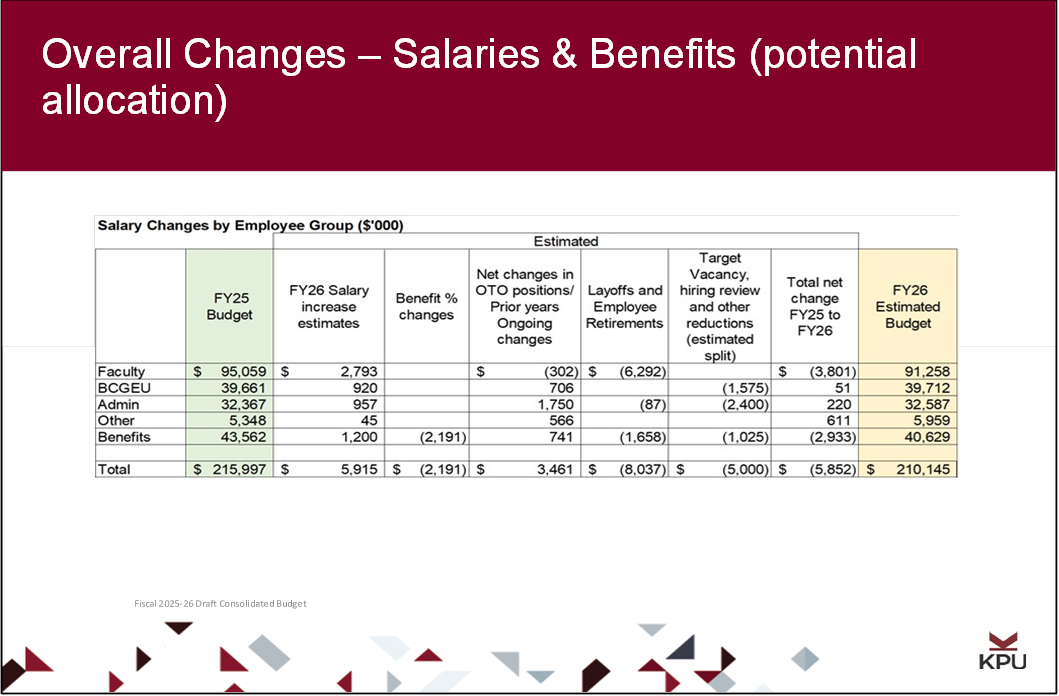
There are a number of problems with these figures and with the reasoning from the outset which I will deal with those below.
But let us be perfectly clear: No layoffs were necessary to meet this target because this reduction target was fully met by the reductions owing to the first sets of retirement incentives that were accepted, plus only a portion of the non-regular reductions named.
I will repeat: the first round of retirement incentives in conjunction with the attrition of non-regular work fully met the targeted financial savings identified by the Employer. No layoffs were necessary to meet these targets.
Faculty FTE was reduced by 30.3 FTE by the accepted retirement incentives. This alone accounts for much of the salary and benefits reduction target. The criteria for retirement incentive offer means that to accept an incentive, the member must be at top of scale. The 33 faculty FTE translates as approximately $3.488M reduction in faculty salary alone.
During the consultations, the Employer told us the reductions in non-regular faculty were incorporated into the overall faculty reduction target, which is completely proper as there can be NO non-regular use where regular faculty have been laid off, and post-layoff, NO non-regular use where laid off faculty can be recalled. The Employers’ figure for non-regular reduction was 40.725 FTE. At a mid-scale rate, Step 7 (almost no faculty including NR faculty enter the scale at or below that step in reality, so this is the very basement estimate – many NR faculty actually are at top of scale), the salary reduction due to non-regular work reduction is $3.784M .
These two categories alone total more than the entire reduction target. The total salary reduction for these two is $7.272M. This is nearly $1M more than the target.
Thus, even if the projections of faculty salary reductions were correct, and I repeat, we say they are not, then by the Employer’s own terms, the layoff notices and the laying off of faculty was excessive and unnecessary.
Excessive Reduction of Faculty
Furthermore, the accepted retirement incentives, plus the plus the reductions in NR1 and NR2 use, plus the layoff mitigation retirements and severance acceptances, plus the actual layoffs, all taken together constitute a significant total reduction in faculty FTE far in excess of the FTE the Employer claimed was “necessary” in the first place.
Why do we say this is excessive? The increases of faculty FTE owing to the international student “boom” began in 2016. But the Employer has dropped Faculty FTE back to at least 2010/2011 levels.
To be very specific:
The September layoffs stand at 27.375 FTE. There are 7 more layoffs to add to that total, including the “deferrals” (see below) and the January layoffs, if all of the impending layoffs go forward.
The retirement reductions accepted in the first rounds of offers before the layoff notices, stand at 30.33 FTE. (Note this does not include the mitigation retirements and severance acceptances and other exits that we know of, which total at least about another 10 FTE, final figures not confirmed, so not added here).
The reductions in NR use according to the Employer’s own figures stand at 40.725 FTE.
This is a total reduction of faculty FTE of at least 98.43 FTE.
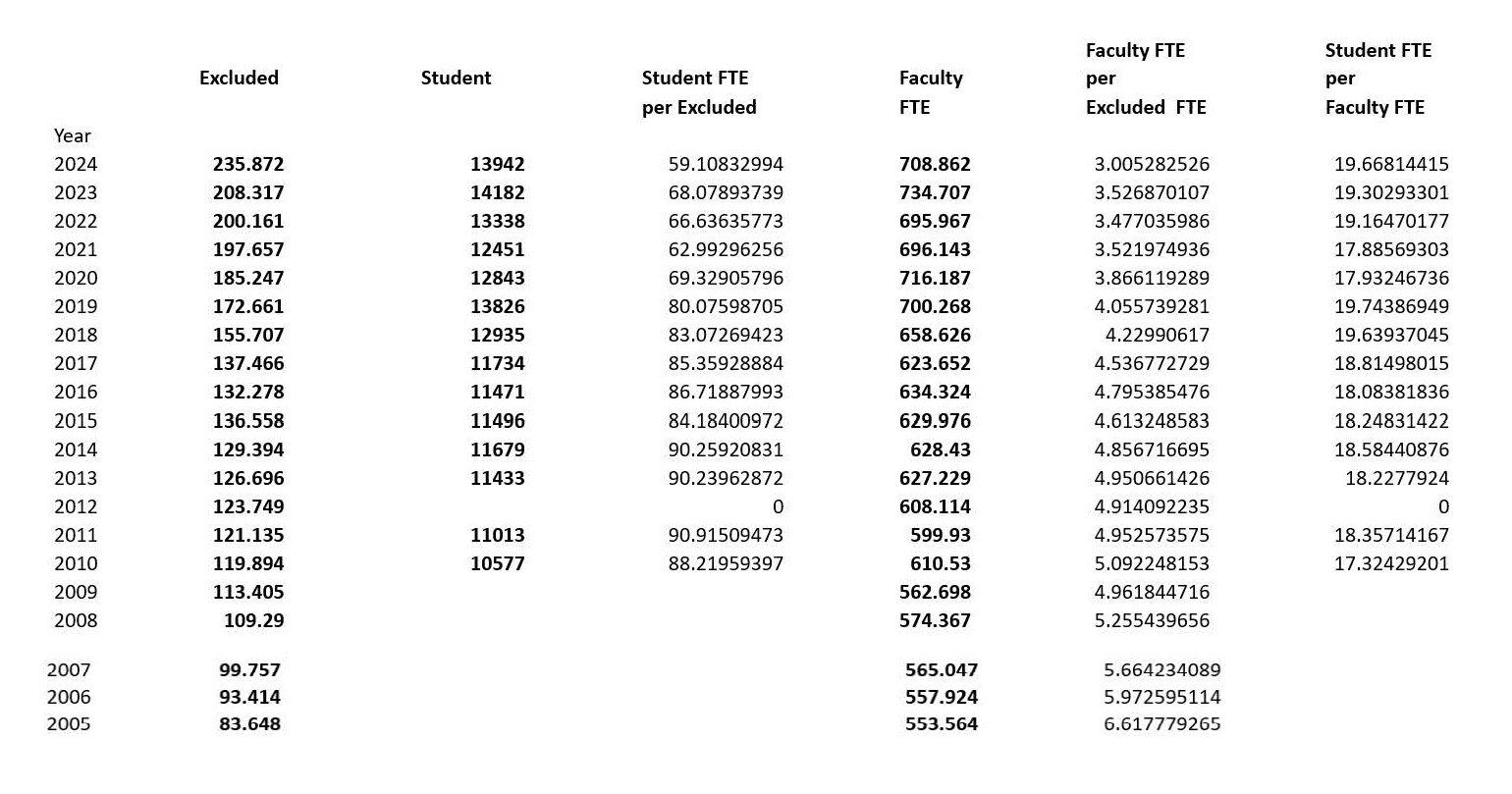
The last complete faculty FTE figure we have, for the year 2024, faculty FTE stood at 708.862. We know faculty were reduced in the year ending 2025, but working from the last known figure, and subtracting all the reductions outlined, these unnecessary layoffs will reduce faculty FTE down to 610.432, more likely about 600 FTE, and certainly less than that at the end of all impending actions.
This will take faculty FTE back at least to 2010/2011 faculty population. This is grossly excessive and is not justified by the enrollment reductions. Even in the worst-case scenarios, student enrollments are not projected to roll back to the same as that year. They are not even projected to roll back to the same as they were in 2016.
Here are the figures, taken from the Human Resources Database which is compiled by PSEA (gov), and for the student FTE taken from KPU’s Accountability Reports submitted to gov. These are amalgamated in the following table (note figures for 2025 are not yet posted, and further note the blanks are due to data not being available from the annual accountability reports:
Student and Administration Increases Since 2016
By comparison, the increases to student FTE since 2016, around the time of the international student enrollment “boom” began, is about 21.5%. Faculty FTE increased by a lower percentage, 11.8%, lower because student FTE is calculated differently, roughly 6 sections per student FTE versus 8 sections per faculty FTE. In addition, student FTE / faculty FTE ratio increased slightly during this period. In contrast, administrative FTE increased during this same period by about 78%.
[Explanatory Note: For those amongst us who don’t do this every day, I will remind us that percent change is calculated as follows: new number (the 2024 FTE figure) minus the original number (the 2016 FTE figure), with the result divided by the original number (the 2016 FTE figure) and then the result x 100. This gives us the percentage change in FTE from 2016 to 2024.]
Looking at the ratio of admin to students and faculty, we can see this has declined significantly during this period, too, from 86.7 students per admin in 2026 to 59.1 as of 2024, and from 4.79 faculty per admin to 3.0 faculty per admin in 2024. Admin / faculty ratio after layoffs will be significantly less than 3 faculty FTE per admin FTE.
With admin FTE for the year ending 2026 standing at least at 235.872 (recall there were no reductions in the 25/26 budget), and faculty FTE being reduced to at least 610.432 and likely less, the ratio of faculty to admin, or in other words the administrative density, will be 2.58 faculty per administrator. Note these are drawn off 2024 figures, which do not show increases to admin over the year ending 2025 or the reductions to faculty before the layoffs started. We expect the ratio to be even lower.
This kind of administrative density is not only unnecessary, but it is also quite absurd. We understand that the upcoming budget for 2026/27 includes a reduction in administration, but I believe this is an insufficient reduction given the massive increase in administration during the period since 2016 and the massive reduction in faculty in the current fiscal. Given that there are proposed further significant decreases in faculty, the administrative density will not be reduced; rather it quite likely will increase even more. Maintaining excessive administrative density seems to be in direct contradiction to the claims of fiscal shortfalls, does it not? We would suggest that this extravagance nullifies those claims.
Most telling, during one of the Step 3 meetings, the Employer confirmed that administrators’ salary is determined in part by number of direct reports, and that once an administrator has achieved a certain salary level, their salary is “red circled” or in other words it is not re-evaluated based on having less workload. The ability of the Employer to artificially increase and then maintain numbers of excluded admin, an increase that directly financially benefits senior administrators and artificially expands the costs of administration, seems to us to be extremely problematic.
Problems with the Rationale and Calculations – KPU Does Not Need to Cover the Full cost of Faculty Salary
The initial net target, $3.8M, was incorrectly calculated, in our view. To come up with that reduction target, the administration incorrectly calculated faculty reductions on the basis of 100% of salary and benefits.
Why is this incorrect? There is a simple but important fact that the Employer has failed to mention: The full cost of faculty salary is not borne by the institution. The government pays directly for at least 60% of faculty salary as of the 2022-2025 Collective Agreement. Tuition revenue does not have the relationship to faculty salary and benefits costs that the Employer has claimed. Faculty are not somehow beholden to deliver tuition revenue equaling the full cost of their salary and benefits.
How do we know this? In every single round of bargaining since at least 1995, the BC government has fully funded all salary and mandated benefits increases for faculty. This was part of the public sector compensation mandates, and the gov includes this in the grant to KPU every single year. Thus, tuition fee revenue funds a minority of the total cost of faculty salary. (Note: The gov was already funding a hefty chunk of faculty compensation at the time the mandates began, which we have not included in these calculations, and this is one of the reasons we believe this is an underestimate. We are being generous to the Employer’s position, here.)
However, despite this fact of direct government funding without regard to tuition fees, the Employer calculated faculty salary reductions on the basis of no gov funding for faculty salary. Thus, they estimated and carried out layoff notices and layoffs based on incorrect data from the outset.
This is a gross failure on the part of the Employer to properly frame salary mandates. It is a gross failure to properly calculate faculty salary reductions in this situation, or it is a gross misrepresentation, and a means by which to manufacture conditions for faculty layoffs.
When confronted with this, and directly asked if the gov was going to stop fully funding the salary increases since 1995, multiple administrators responded by saying that the direction from gov is not to include the grant in their budgeting, but when pressed, they admitted that this is due to the reductions in the base grant directly owing to faculty reductions, not an overall change in the way the grant is figured. Thus, the layoffs have further contributed to a reduction in institutional revenue. Now, for the upcoming 2026/2027 proposed budget, we see it includes the grant unreduced. This is mighty curious given that the grant is predicated in great part on the full funding of salaries, and faculty salary is the major salary line item.
Faculty Salary and Benefits True “Break-Evens”
Our position is that the Employer has incorrectly calculated faculty salary “break-evens” and thus incorrectly calculated layoffs on the basis of incorrect salary figures and incorrect break-even enrollment in each of the targeted areas. The Employer used full class sizes in order to arrive at the number of layoffs, using their worst-case scenarios of enrollment projections. But this is inaccurate.
At top of scale, the true break-even on gross faculty salary and benefits for each section, based solely on current tuition fees and on the full funding since 1995, and not on any other revenue sources, is approximately:
- 22 domestic student enrollments per section (which yields excess revenue) with no international enrollments, or
- 5 international student enrollments (which yields excess revenue), and
- Proportional admixtures of domestic / international enrollments.
These break-evens are calculated for individual sections and at top of scale, using a 125% of salary basis to estimate benefits costs. We must recall that many faculty are not at top of scale, and that the full funding of faculty salary applies not only to faculty who teach classes of registered students, but to all faculty. Thus, the total faculty salary and benefits costs are amply met by enrollments that total much less than full classes.
Here is the salary scale from 1995:
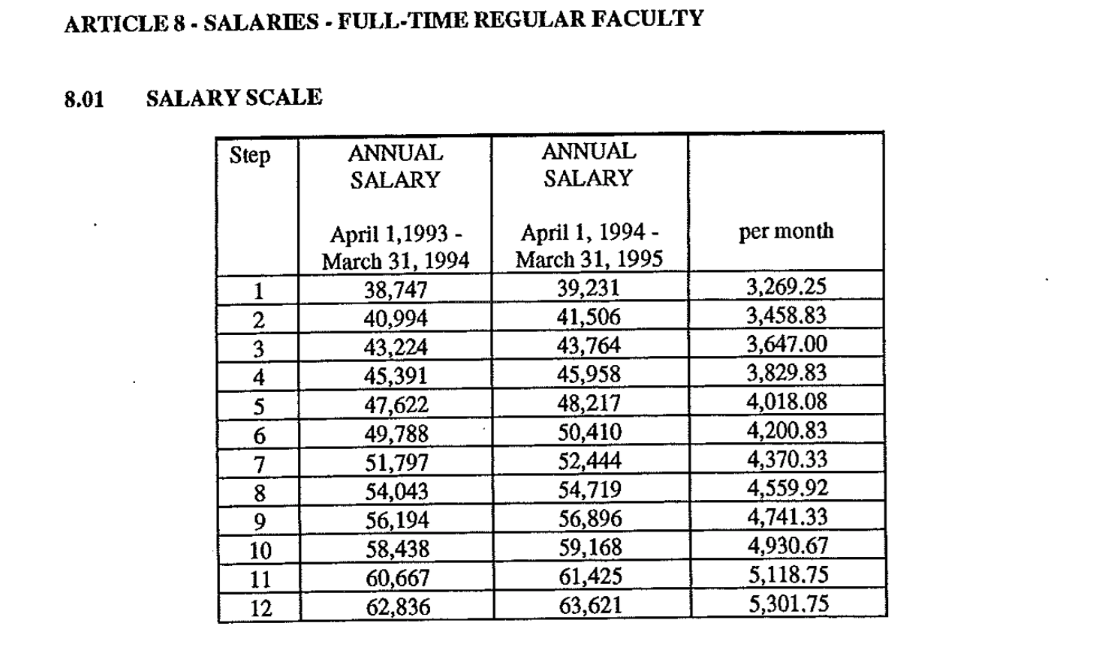
Across the steps, I have estimated this increase to be an average of about 60% increase to present.
I will point out again that viewing the calculations this way above (22 domestic or 5 international) is not favourable to the KFA’s position; it is favourable to the Employer’s position because it is calculated at top of scale and there are many faculty not at top of scale, especially after the retirements. Faculty who are not at top of scale nevertheless have the same “revenue” from enrollments, and thus we are underestimating the total net revenue generated by any faculty member not at top of scale. Also, there are numbers of revenue streams in addition to tuition fees that are not taken into account, and which faculty have contributed directly towards. One example of this is the investment income as a result of the massive accumulated budgetary surpluses gained directly through faculty labour. So again, this way of looking at things is extremely conservative to the faculty position and extremely favourable to the Employer’s position.
In addition, with regard to “breaking even” and revenue, I will point you again to the chart above that shows total student FTE, total faculty FTE, and total administrative FTE. During all of the years in which total student/faculty FTE was between 17 and 19 student FTE to faculty FTE, the institution saw massive revenue surpluses year after year.
Thus, by calculating layoffs on the basis of 100% of faculty salary and benefits, and projecting layoffs based on shortfalls of sections enrolled at maximum capacity, and proceeded on these incorrect bases to cancelling sections and laying off faculty, the Employer has not only incorrectly issued layoff notices, but has also reduced institutional revenue solely as a result of cancelling the sections and laying off faculty.
Cutting Sections Early Results in Enrollment Declines
The claim on the part of the Employer, that the same number of student enrollments will result from a reduced number of sections, is not rational and has not occurred either historically or at present.
In comparison to the Fall 2024 semester, the number of fulltime students has decreased as a proportion of all students, and students overall are enrolling in fewer sections. If student enrollments were not affected by reductions in section availability, then we would expect to see the numbers of sections per student remaining the same on average. They have not.
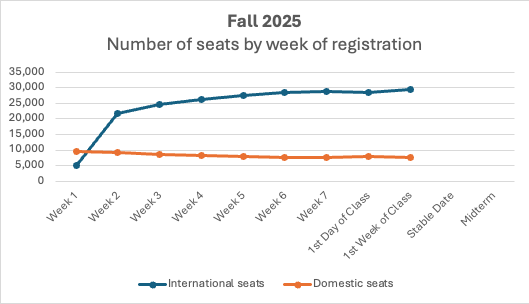
Furthermore, there is a consistent pattern of steady increase in the fill-rates of registration during the first six weeks of registration, which shows that any cancellations that occurred during this period are not a consequence of lack of student demand, but rather in and of themselves, they are the cause of reduced enrollments.
Here are the overall enrollments for the past three Fall semesters in terms of numbers:
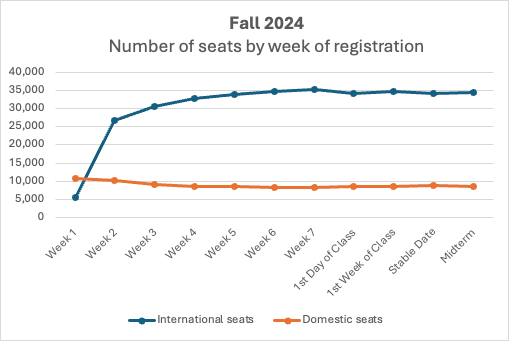
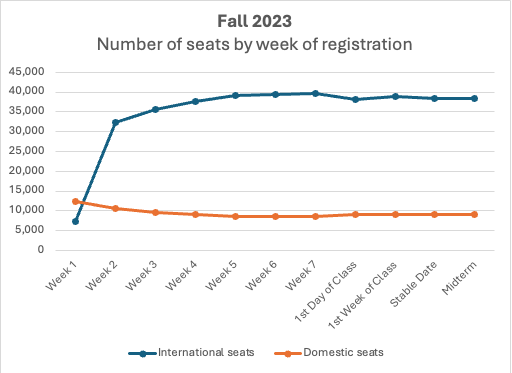
Here are overall enrollments shown as percentage of fill rates:
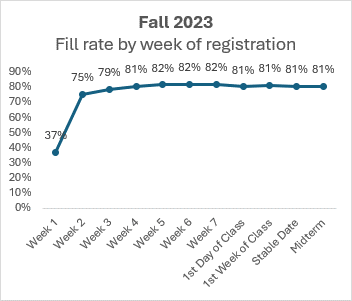
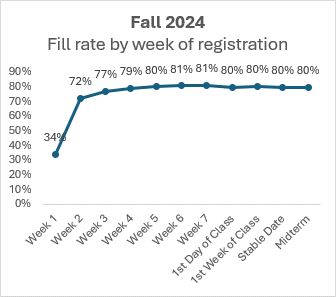
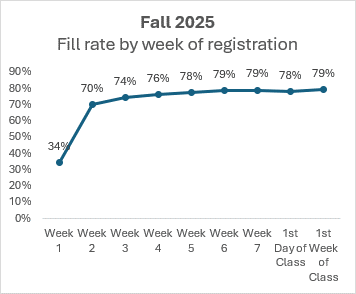
The Employer cut sections in the first 2 weeks of registration. Thus, the week 1 and week 2 section cuts themselves have created the conditions for reductions in enrollments, and this is one of the ways the Employer has manufactured conditions for layoffs by their actions.
We also heard in public statements that the Provost’s position is that “we can’t have faculty standing in front of empty classrooms,” and I think we have to wonder if this public position is behind the decision made by the Provost to close sections very early in the registration process. We asked the Provost to reverse this as soon as we saw it happening; the Provost refused.
No Fiscal Shortfalls
Furthermore, there was and is no institutional fiscal shortfall.
During the last two past fiscal years, there have been a significant surpluses, including a confirmed $10M surplus in 2024/25 (when the layoffs were projected and planned for the current fiscal), and there is a projected surplus of between $5M to $10M for the current 2025/26 fiscal, according to the Chief Financial Officer. This was stated publicly on a number of occasions.
It is interesting to note our understanding of events that occurred at a recent grievance meeting where the administrator present said, “We are not going to project a surplus. We are going to project a balanced budget or slight deficit,” and when the Union queried this and suggested that the CFO should know better what the actual fiscal position was, the administrator said, “I will have a word with him.” This does not inspire confidence in the Employer’s statements.
I will repeat: the government has allowed institutions to use their accumulated surpluses, which KPU has in the hundreds of millions, and/or to run deficits.
We say again: There was and is no fiscal crisis. There is and was no need to take this extreme kind of action.
We say again: the Employer has manufactured conditions for faculty layoffs.
In summary, these layoffs were not necessary from the outset:
The layoffs were not justified in terms of matching faculty complement to student enrollments per historic enrollment patterns.
The layoffs were not justified in terms of salary reduction targets in the approved budget.
The figures used as the basis for calculations are incorrect, and incorrect data was presented to the Board and to all of the interested groups at the university including the KFA.
The funding of faculty salaries has been misrepresented.
The early closure of sections has only added to the enrollment reductions.
Thus, the layoff notices and the executed layoffs are not in any way justified and are grossly excessive. They constitute an attack on faculty, an attack on the bargaining unit, and a deliberate increase in faculty precarity of employment.
Additional Errors Made during the Layoff Processes
In the course of these layoff notices, the notice period, and the layoffs that have been executed, a number of further errors were made by the Employer.
These include:
- Incorrect layoff notice meetings
- Issuing layoff notices and laying off faculty using incorrect FTE order
- Incorrectly issuing notice to members on maternity / parental leave
- Incorrect processes with regard to adding qualifications for reassignment / recall
- Incorrect position on members with multiple areas of qualification
- Refusing to take every means available to avert layoffs and ignoring mandatory language regarding layoff mitigation
- Incorrect position on reassignment rights and recall rights with regard to requiring members to apply for postings and limiting reassignment and recall rights post-layoff on this basis
- Incorrectly calculating severance pay for part-time faculty and those partially laid off
These are just some of the errors. In quite a number of instances, the Employer has foreclosed faculty members’ rights on the justification that there were so many individuals issued layoff notices at the same time. We will say as we have said repeatedly to the Employer: Individuals’ rights cannot and must not be foreclosed as a result of the Employers choice to issue 70 layoff notices at one time. But this is what the Employer has chosen to do.
I will not detail all of these in full, but I will describe a few that we find most troubling.
Incorrect FTE Order
There were numbers of violations to layoff order under 7.02 as a result of the Employer arbitrarily determining “Domicile Departments” for members of the Melville School of Business and not properly assigning members according to their qualifications in the MSB. (We have filed a separate grievance on the imposition of “domicile departments.”) There were also a few examples of this general circumstance in Arts, not assessing faculty members properly on the basis of all of their qualifications, though not the unilateral assignment of an official “domicile department” to members.
Members who have been working in multiple disciplines / programs have had their rights limited to a single discipline, instead of having all of their rights considered. For example, a member who has been working primarily in one discipline for years was arbitrarily moved to a different one as their “domicile,” and this move resulted in their receiving layoff notice. In numbers of instances, we are not convinced layoff order is correct.
It is unclear to us exactly what members have been laid off from, where their rights to work reside, and whether they were in fact laid off in correct order because the FTE lists did not and do not correctly list disciplines, and they do not note the multiple disciplines faculty are entitled to work in.
Many of the members who have received notice in MSB have been teaching in multiple programs/disciplines, and a number of the members were originally regularized in one area but have been teaching exclusively or mainly in a different one. A number of members were regularized in one area and then confirmed in writing they were also appointed in an additional area or areas. A number of members were regularized in “the School of Business” in general terms. Their FTE in the list does not reflect this reality. A number of people are listed in the FTE list only under “School of Business Instruction” with no reference to the disciplines per the requirements of 7.02. Some members actually are listed under one discipline but have been laid off in a different program/discipline. We asked for clarification from the Employer, but it has not been forthcoming. A few changes were made to the FTE list, but the changes do not provide clarity.
In short, the Employer has proceeded to lay people off without providing us complete and correct information on each of the members that shows why they were laid off.
Members Laid off While on Maternity/Parental Leave
Perhaps one of the most shocking decisions on the part of the Employer within this whole shocking situation is the decision to issue layoff notice to members on or about to be on maternity / parental leave, and the decision to execute layoff or partial layoff on four women who are actively on maternity leave.
Maternity / parental status is a protected ground that carries special requirements so as to avoid discrimination. Laying off members while on this kind of leave is clearly discriminatory. It is in clear violation of the Charter or Rights & Freedoms of Canada and the BC Human Rights Code, as well as the terms of the Employment Standards Act, as well as the terms of Article 23 Discrimination and Harassment, according to an abundance of case law. The KFA fully detailed these violations and our reasoning during the grievance process, but the Employer has stubbornly stuck with their position and their actions towards these members. It remains our position that these notices were issued incorrectly and all of them should have been rescinded fully, but three of the women did not have their layoff notices rescinded and were fully laid off during their maternity leave period, and another was partially laid off. We say this is wrong, utterly wrong, and a shameful violation of these women’s rights.
Additional Policy (General) Grievances
The Union has filed several separate policy grievances (“policy” grievances are ones that apply to the whole membership and/or a group of faculty, not just an individual) on topics related to the layoffs.
The following violations have been grieved under the main layoff grievances as well as under these separate ones. The reason for approaching it this way is to ensure we are fully representing the members as a whole and fully addressing all of the violations in this complex situation.
“Deferral” Notices
One of the issues under this grievance is the so-called “deferral notices” which were issued to a number of members. Members whose layoff notice should have been rescinded fully instead were issued a “deferral notice” which is completely improper. This is an arbitrary suspension of the notice period under 7.03. There is one notice period under 7.03, and it is 5 months. If the layoff is not necessary at the end of the 5-month notice period, the member’s notice must be rescinded. If it is necessary at the end of the layoff period, then the member is laid off. There are no other options. If there is a future need to engage in layoffs, then the processes under Article 7 must be engaged in full, without foreclosing any of the rights members enjoy under the mitigation strategies. There are numbers of rights that are specific to the processes under Article 7, and they cannot be foreclosed as a result of the Employer’s decision to issue so many layoff notices at once.
Targeted Labour Adjustments
Another set of violations occurred under Article 7.10 Targeted Labour Adjustment.
The Employer canvassed the targeted disciplines per the article, but the Employer did not properly carry out the mitigations that were possible as a result of the canvassing. The Employer:
- refused to allow faculty under notice to take a leave without pay, per the terms of 7.10 (c) (iv), and
- refused to allow other faculty to take full or partial leaves to mitigate layoff per the terms of 7.10 (c) (ii) and (iv) and instead framed such offers to take leaves as a form of voluntary layoff, and
- refused to explore or consider transfers with minimal training required per 7.10 (c) (iii), and
did not properly carry out search for available secondment per 7.10 (c) (vii), and - would not consider combinations, variations or other workplace alternatives as per 7.10 (c) (ix), and
- Flatly refused to consider any of the mitigations under 7.10 (d) except severance on a cost neutral basis,
All of this is in opposition to the plain language and in opposition to the “Employer commitments” under 7.10 (a) which requires the Employer to find as many mitigations and to avoid as many layoffs as possible. The Employer’s justification for the flat refusals under 7.10 (d) was the lack of “availability of funding” per the language in 7.10 (d), but we maintain that there is no shortage of funding, especially not a shortage of funding to mitigate some of these layoffs.
Severance Pay
The next violations are under 7.08 Severance. The Employer has incorrectly calculated severance as per the terms in the Agreement. The Agreement reads, “they will receive one months’ severance pay for every full year of FTE service to a maximum or ten months’ severance pay.” The Employer is choosing to short members of severance pay who are part-time regular faculty members as well as those laid off partially, by not paying out the full severance amounts based on full months of FTE.
In addition, the Employer has incorrectly calculated the FTE accruals of faculty members by shorting them a day of FTE in pay period (PP) 19, the last PP before layoff. If a member is close to the rolling over of a year’s FTE, then this has resulted in shorting them a month of severance. For members laid off partially, the early cutoff of PP 19 also resulted in them being underpaid for the PP, for a fulltime member, we estimate this at $80 gross for each person. In addition, some members who continue as part-time regular members had their vacation pay paid out involuntarily together with their severance instead of them being given a choice on the matter.
Imposition of Domicile Departments
As I referred to above, the Employer took it upon themselves to unilaterally define members’ employment status by determining and stating what their “domicile department” is and limiting their regularization rights and their rights under Article 7 to this single “domicile,” without regard to where they are qualified and where they have been teaching. There is no such concept or term under the Collective Agreement. This is massive over-stepping on the part of the Employer, and we filed a policy grievance on this specific action.
Management Rights Violations
Management rights are those rights held by the Employer to manage and direct the workforce. These rights must be exercised in a reasonable manner. The purpose of the Collective Agreement is to fetter, or in other words to limit, management rights, and these rights are explicitly limited by the Collective Agreement.
The Employer not only has the right to manage, but the Employer also has an obligation called a duty of care to all employees, and an obligation to act in good faith in carrying out their management rights based on the purposes, goals and objectives of the organization, as well as in good faith regarding their obligations under the Collective Agreement.
In other words, management rights do not exist separately from management responsibilities. We say the Employer has not properly or adequately carried our their responsibilities, much less their duty of care to individuals who have in good faith trusted the institution with their careers and their working lives.
The Employer has not done everything possible to avoid issuing layoff notices in the first place, has not done everything possible to mitigate layoffs, and has proceeded to execute layoffs of faculty members on incorrect and unreasonable terms, and has made multiple missteps along the way. All of these are violations of management rights.
The Employer is not acting honestly in seeking to avoid layoffs or mitigate them. In addition to the specific violations mentioned, the Union’s position is that Management Rights have been violated, for example, in the following ways.
Refusal to Provide Information
The Employer refused to provide the Union with a reasonable amount of information to support their claims. The Union asked for:
- Department fill rates
- Percentage international students
- Current base sections
- Historic and current schedules/education plans
The Employer refused to provide this information. It is puzzling that the Employer would refuse to provide this given it is public and non-confidential information. We explained that it would be very cumbersome and time consuming to gather all of it for all of the disciplines and given that the Employer had issued layoff notices in the areas and thus should have had the information already gathered and collated, one would assume, it should have been a simple matter to provide it for the KFA. But the Employer refused.
As the Employer had refused, the KFA then approached our members, discipline chairs who would have easy access to it, and asked for this information. The Employer (through the deans) then responded to chairs directly, ordering them not to communicate with the KFA, as follows:
It has come to my attention that many of you are being asked by the KFA to provide information pertaining to department fill rates, current base sections, education plans, percentage of international students over the past three years, etc. Please note that this is confidential information belonging to the department to which you are given access in order to perform specific work activities.
We recognize that this matter is putting you into a very uncomfortable position. If you receive a request for departmental information from your union, please let them know that you do not have permission to share confidential information outside of the department and that if they have questions or requests for additional information, they can direct them to the Dean.
and then communicated the following to the KFA,
As you acknowledge in your email, the Employer has declined to provide you with the information you are requesting; and as explained above and previously, the Employer is not required to provide the level of detailed information being requested. The information is owned by the University, and the KFA’s request for this information was denied by the University. Despite this, the KFA took the step of requesting the information from KPU employees who are not authorized by the University to provide such information. The communication to the Chairs to refer these types of questions to the Dean is completely appropriate. Further, the KFA has put these employees in a precarious situation with its request.
Please desist from requesting that Chairs provide you with this information. Requests for University information should be directed to the Deans or to Labour Relations.
All of this information is public, non-confidential and non-proprietary, and in this context necessary for the KFA to adequately determine whether the layoffs were in fact legitimate or not. The Employer’s actions and communications to the chairs and to the Union were entirely inappropriate and were in our view tantamount to threats issued both to chairs as well as to the KFA. This is an abuse of management rights.
Financial Mismanagement
Faculty members are bearing the brunt for a long period of financial mismanagement on the part of the Employer, and this is a patent abuse of management rights.
The Employer was informed by successive CFOs that the over-reliance on international students to underwrite burgeoning University budgets was a significant risk, to no avail. During this period, four successive CFOs have exited the institution within a relatively short period of time, with not much in the way of explanation for their departures.
And faculty members are paying for this mismanagement and this failure to adequately assess and act appropriately upon the risks, with no apparent accountability or consequences for administrators.
Harming Institutional Reputation
We believe the Employer is harming the institution as a whole as a result of their actions, which we believe has negatively impacted institutional reputation, and will continue to do so.
These cuts will negatively and directly impact all students in programs requiring these courses by making it more difficult for them to finish their programs and credentials. This is coming at a time when we have all heard from students that they were already having difficulties finishing programs and credentials. In turn, this harms KPU’s reputation with students and parents and others, and this damage is very likely to cause further attrition and further declines in new applicants.
Institutional reputation is also at risk when the total set of actions is compared to other public post-sec institutions. No other institution in our sector of public post-sec in BC is taking this kind of extreme action, and this is harming KPU’s reputation with students and with faculty as well as with the communities. Numbers of domestic students are decreasing and have been for years, in the region with the strongest growth in domestic post-sec aged students in the province. For comparison, from last Fall semester to this one, there has been a decline of 90 students for that semester. This is about a 1% decrease by headcount: 9378 for Fall 2024 vs 9288 for Fall 2025. (This is using the institution’s own enrollment tracker.) Numbers of adults who do not have any post-sec are also, I believe, the highest in our region. Yet KPU has axed or reduced programs that allow mature students to enter KPU, and domestic enrollments continue to decline overall.
At least one member whose layoff notice was rescinded has declined to remain at KPU. Another whose layoff was partially rescinded has just left KPU this week. We also understand that other faculty who have not been laid off are leaving KPU if they can. We also understand that community-based programs of a number of kinds are having difficulty retaining community partners or attracting new ones.
This is all the responsibility of the Employer whose actions are harming the entire institution.
Why is the Employer continuing to undertake this set of actions? What can they be hoping to gain from it?
One easily could speculate that it is in part the bolstering of their own salary calculations, as per above. But that would not explain the whole thing.
These administrators have long held and acted upon the desire to increase faculty precarity and reduce numbers of regular faculty. One could speculate that these long-held aspirations are being aimed at. They have also long held and acted upon the aspiration to take work outside of the bargaining unit. One could also speculate that the long-held aspirations of the Employer to take faculty work outside the union to make it non-union work in CPS are also being aimed at.
Why would they want these things? I will point at a few facts:
Non-regular faculty work costs less in numerous ways than regular faculty work, and NR1 work costs only about 2/3 as much as regular faculty work. Non-regulars have no right to ongoing work, except through the regularization rights in the Agreement which the Employer is currently actively seeking to undermine, alongside undermining recall rights. NR1s have no access to benefits. All of this amounts to precarity of work that lends itself to all the ills that go along with that, including a much more controllable and much more disposable workforce.
CPS non-bargaining unit work likewise generally costs a lot less to deliver than bargaining unit work. People developing or delivering CPS non-bargaining unit courses have no rights to any of the benefits or provisions of the Collective Agreement. For example,
- members who develop CPS non-bargaining unit courses have no intellectual property rights to the courses or curricula they develop, and
- members who develop CPS non-bargaining unit courses have no guarantees to ever deliver the courses they create or to continue to deliver the courses they create, and
- members who deliver non-bargaining unit CPS courses have no academic freedom rights
- members who deliver non-bargaining unit CPS courses have no rights to take the courses elsewhere to teach
- members who deliver non-bargaining unit CPS courses. They have no access to FTE accruals and thus no access to any of the rights around FTE including accrual of FTE to prevent layoff or to access salary increases.
- members who deliver non-bargaining unit CPS courses They have no access to health benefits or pension contributions.
These are just some examples. All of this amounts to a clear advantage to the Employer from preferring and promoting non-bargaining unit work in CPS, both financially and, again, in having a more precarious, disposable and controllable workforce.
Thus, what is being framed as “flexibility” seems to come directly at the expense of faculty members’ jobs, lives and working conditions.
Final Thoughts
Management rights must live alongside management responsibilities. Every single individual who has chosen to commit their working lives to KPU must be treated with respect and must be cared for to the utmost of management ability. KPU management has not lived up to this, I think it is fair to summarize.
The explicit mandate of the institution is to serve the citizens of the region. The region now houses two fully funded research universities, SFU and UBC. Other public post-sec institutions also carry on storefront operations in our region. There are ever-increasing numbers of private institutions that have set up shop in the KPU region to meet the needs we are not meeting.
Isn’t it time to shift focus to what it is that this institution can do really well? Isn’t it time to develop and grow a niche that we realistically can fill? Isn’t it well past time to find ways and means to adjust to changes in ways that do not needlessly take an axe to faculty members’ jobs, careers, and lives, and that instead address and adapt to the reality in which this institution operates? Is it not?
One would hope that the goal would be to raise up faculty, empower them to be wonderful educators, support them as best possible in their endeavors, fill them with energy, and fully act upon the duty of the employer to care for the people in their employ.
One would hope that the aim would be to set all of us to work rebuilding KPU not in a fashion that cuts the legs out from under people but that sets us on a realistic and viable path forward to find our own niche, not to try to compete head to head with large universities that are operating in the heart of our region or elsewhere, but to figure out what do we do well and how can we enhance those things, and what needs are unmet and set about to meet them.
One would hope that the ultimate goal would be to have KPU become a place of strength for the communities that we serve, for our citizens, for our students and for our faculty to have confidence in.
One would hope that the new president would want to embrace a different way of viewing faculty, not as barriers to their own aspirations but as what we are: the curricular and teaching experts of the institution, whose expertise and positions must be respected.
In solidarity,
Diane.
First Call for Nominations for 2025 KFA Elections
Dear Kwantlen Faculty Association Members,
In accordance with Article 7 of our Constitution and By-Laws, this is the first call for nominations for the following positions on the KFA Executive Committee and the KFA Working Conditions Committee (WCC):
- Humanities Representative (until end of term, May 31, 2027)
- Trades & Technology Representative (until end of term, May 31, 2027)
- Ombudsperson (until end of term, May 31, 2027)
- Qualifying Studies & Access Representative (until end of term, May 31, 2027)
- Academic Governance Committee Representative (until end of term, May 31, 2026)
- WCC Non-Regular Faculty Representative
Please see the attached document titled “Responsibilities of an Executive Representative” and By-law 4.2 for information about these roles. Please also see the new KFA Conflict of Interest Policy.
Nomination Period – Nov. 10-Dec. 1, 2025
The nomination period runs from Nov. 10 to Dec. 1, at noon. Nomination forms are to be sent to the Chief Returning Officer (C.R.O.), Marc Kampschuur. Three calls for nominations will be made during this time period. In the event that the call for nominations results in only one nomination being received by the close of the nomination period, the nominee shall be acclaimed at the General Meeting on December 2, 2025. If there is more than one nominee, an online election will be held.
If you have any questions, please don’t hesitate to contact me. You can find more information about the election process on our website.
Marc Kampschuur, Vice-President, Negotiations
Officer Responsible for the Election
