


NCIS Media Release to Institutions
Please click the following link to see the latest release from The National College of Indigenous Scholars:
NCIS Media Release to Institutions
Last Call for Nominations for 2026 KFA Elections
Dear Kwantlen Faculty Association Members,
In accordance with Article 7 of our Constitution and By-Laws, this is the last call for nominations for the following positions on the KFA Executive Committee:
- President (until end of term, August 31, 2028)
- VP-Negotiations (until end of term, August 31, 2028)
- Member-at-Large (until end of term, August 31, 2028)
- Science & Horticulture Representative (until end of term, May 31, 2028)
- School of Business Representative (until end of term, May 31, 2028)
- Faculty of Health Representative (until end of term, May 31, 2028)
- School of Design Representative (until end of term, May 31, 2028)
- Trades & Technology Representative (until end of term, May 31, 2027)
- Qualifying Studies & Access Representative (until end of term, May 31, 2027)
- Non-Regular Faculty Representative (until end of term, May 31, 2028)
- Status of Women Committee Representative (until end of term, May 31, 2028)
- Occupational Health & Safety Committee Representative (until end of term, May 31, 2028)
- Academic Governance Committee Representative (until end of term, May 31, 2028)
- Pension Advisory Committee Representative (until end of term, May 31, 2028)
Please see the attached document titled “Responsibilities for an Executive Committee Member” and By-law 4.2 for information about these roles. Please also see the new KFA Conflict of Interest Policy attached.
Nomination Period – March 23-April 14, 2026
The nomination period runs from March 23 to April 14, at noon. Nomination forms are to be sent to the Chief Returning Officer (C.R.O.), Diane Walsh. Three calls for nominations will be made during this time period. In the event that the call for nominations results in only one nomination being received by the close of the nomination period, the nominee shall be acclaimed at the Annual General Meeting on April 15, 2026. If there is more than one nominee, an online election will be held.
The nominations received to date are as follows:
| Nominee | Nominator | Position |
| Phaedra Burke | Mark Diotte | President |
| Mark Diotte | Marc Kampschuur | VP-Negotiations |
| Rebecca Yoshizawa | Sara Naderinajafabadi | Member-at-Large |
| Science & Horticulture Representative | ||
| School of Business Representative | ||
| Faculty of Health Representative | ||
| School of Design Representative | ||
| Trades & Technology Representative | ||
| Qualifying Studies & Access Representative | ||
| Non-Regular Faculty Representative | ||
| Status of Women Committee Representative | ||
| Occupational Health & Safety Committee Representative | ||
| Marc Kampschuur | Gillian Dearle | Academic Governance Committee Representative |
| Richard Le Grand | Kyle Matsuba | Pension Advisory Committee Representative |
If you have any questions, please don’t hesitate to contact me. You can find more information about the election process on our website.
Diane Walsh, Vice-President, Grievances
Officer Responsible for the Election
Notice of Amendments to the KFA Constitution and By-Laws
Dear Kwantlen Faculty Association Members,
In accordance with By-Law 3.4.1, this is notice of changes for By-Law # 1 and #5
I. CONSTITUTION
NAME
1.0 The name of the Union Society is “Kwantlen Faculty Association,” hereinafter referred to as the Association.
BY-LAW #5: TABLE OFFICERS
5.6 Member(s)-at-Large
5.6.1 One or more Member(s)-at-Large are independent elected Table Officers of the Association whose primary duty is to represent the members of the Association. Member(s)-at-Large also assist the President, Vice-President—Grievances, Vice-President—Negotiations in carrying out their duties.
5.6.2 The duties, priorities, and work of the Member(s)-at-Large shall be determined by the Table Officers collectively as a group to ensure fair and appropriate distribution of responsibilities.
MOTION: To approve the changes to By-Laws #1.0, #5.6.1 and #5.6.2 as recommended by the KFA Executive.
If you have any questions, please don’t hesitate to contact me.
Diane Walsh, Vice-President,
Officer Responsible for the Election
Hold the Date for the KFA AGM – 3:00-6:00 pm on Wednesday, April 15, 2026
Please join us:
KFA Annual General Membership Meeting
Wednesday, April 15, 2026
3:00 – 6:00 pm
Via Zoom
On the Agenda:
Bargaining Update
2026 Elections and Acclamations
Changes to Constitution and By-Laws
KFA 2026-27 Draft Budget
Information in Support of the Special General Meeting Resolutions
Dear Colleagues,
In response to requests from some KFA members for more data and discussion regarding non-confidence in administration, I am presenting here below data and expanded discussion to reinforce and further illuminate that already provided. Wherever possible, direct links to sources are incorporated in-text, and where that is not possible, attachments are provided.
As you are likely already aware, the KPU administration (aka the Employer) has just issued layoff notice to 77 more regular faculty members. The planned layoffs will be effective August 31, 2026, at the start of the next academic year. They are also laying off four NR2 faculty members effective the same date. Two of these are regular faculty members laid off last year. These members should have been recalled to a regular position and should have had full rights to mitigation now, but they will not have any of these opportunities (yes, it has been grieved and we will add this to the grievances).
These actions are examples of an ongoing pattern of decisions and actions that appear to be based on questionable priorities and faulty reasoning, and that have resulted in what amounts to massive sections and programming cuts, and as a result massive job loss for non-regular and regular faculty.
The reasoning presented by the Employer to justify all of these layoffs is the same: reductions in international enrollments leading to reduced revenues. This reasoning is in our view faulty. Additionally, a new spin was provided for laying off a large portion of developmental education faculty and further cutting these offerings, which we maintain is also faulty. I will detail this below.
The KFA requested these layoffs be immediately cancelled and that corrective actions take place instead. The Employer has rejected all these requests. As a result, all these people have been issued layoff notices, even though we have cited significant issues and problems not only with the layoffs themselves and the rationale for them, but the processes surrounding the layoffs. This has included: lack of proper consultation, FTE anomalies, qualifications for programs / disciplines not being properly taken into consideration, qualifications in programs/disciplines being arbitrarily determined by the Employer, severance pay calculation errors, and so on. The current issues with FTE order and qualifications are being raised and corrections requested, and the larger scale problems (FTE, severance pay, and so on) have been grieved and are working their way towards arbitration.
I want to be exquisitely clear:
There is no need for these layoffs now, and there was no need for the layoffs during this past year. All of these layoffs have been presented as necessary, but this is not the case. They are based on problematic and faulty priorities, and some problematic budgeting practices. The budget decisions that have resulted in section cuts and faculty layoffs are all a choice on the part of current administration, not a necessity.
I attended a layoff meeting this past week in which a senior administrator said they were, “not spending money on anything we don’t need to spend money on. (…) We need to keep things that are important.” This was to a group of faculty members receiving layoff notices. These people were informed by the senior administrator in their layoff meeting that they and the discipline they belong to are not “important” in the view of the administration.
The way the budget cuts were structured, and the resulting layoffs are a deliberate choice amongst alternatives. This deliberate choice has been made based on the current senior leadership making judgements about relative importance of activities within the institution. They have set priorities that privilege a lot of items higher than delivery of programs and courses to students, and they have chosen to retain certain people and not retain others based on those choices. They are then framing these choices as “needs” and “necessities.” We dispute this, and we say it is neither prudent nor necessary, and that the actions are directly harmful to the institution in a number of ways as well as to the faculty members impacted.
Summary
I will present discussion and data around several main points. They are in summary:
- The current administration is filled with interim (unsearched) appointments at senior levels. Other key positions are unfilled and some of them have been unfilled for a significant period of time. This raises significant concern regarding the ability of the current senior administration to properly fulfill the institutional mandate and to effectively administer the institution.
- All of the faculty layoffs are the result of significant cuts to programming. That is, the current administration is making significant cuts to frontline services to students. Since the program suspensions and closures and the section cuts and layoffs began, according to the Employer’s own data, the number of seats offered has declined by 18,041. These cuts are having and will have serious consequences for students, including reduced course and program options and delayed graduation timelines. Premier David Eby has committed publicly to protecting frontline services.These cuts and resulting layoffs contradict that commitment. These programming and section cuts that resulted in the layoffs also fly in the face of the mandate of the institution, and quite likely to provisions of the University Act.
- These section cuts and resulting layoffs are not the result of unforeseeable circumstances. KPU administration has known about the risks associated with over-reliance on international student tuition since at least 2018.
- During that entire period of risky growth in international enrollments, increases to administrative positions, salary and FTE occurred well outside of proportionality with both student and faculty FTE. And, during this current period of declines in student FTE and faculty FTE, administrative salary and FTE are not declining proportionately.
- These layoffs are the result of budgeting decisions that we say are rife with inconsistencies. For example, last year, the administration budgeted approximately $13 million for contract staffing, confirmed for us in a meeting with the CFO as contract faculty, but they did not spend this on faculty salary… while simultaneously laying off regular faculty members. This is now characterized as “budget rightsizing” by admin. There are other inconsistencies and problems.
- These layoffs disregard not only the institutional mandate and the Premier’s directives regarding frontline services, but they also disregard the provision of direct funding from gov for developmental education. The institution is continuing to receive funding for the provision of developmental education (upgrading and English language courses) at the same level as is currently provided. But the admin are cutting beyond that funding level, thus are diverting funds from their expressly intended purposes. This is not only a puzzling approach, but it is also a significant risk.
- These layoffs disregard a longstanding fact about the block grant: PSEA has guaranteed faculty salary increases are *fully funded* since about 1993. We agreed with the salary mandates because of this promise, which is a preventive measure against exactly the kind of broad scale layoffs we are experiencing. Instead of honouring this promise, our administrators have been using these funds for other things and intend to continue using these funds for other things. When we asked explicitly why they are not devoting the funds transferred for faculty salary to faculty salary, they said to us this week, “There is no Ministry expectation that grant funding fully cover faculty salary costs. In practice, the grant forms one component of the University’s overall funding, which also relies on tuition and other sources of revenue to support institutional operations.” We asked the Employer explicitly: If this is true, then either a) the gov through PSEA has been misleading us in bargaining mandates this whole time, or b) the current administration is misstating the truth to us. Which is it? That question remains unanswered.
In short, it appears apparent to us that the decisions that are being made by senior administration, including the cuts to programming and resulting layoffs to faculty, are not in the interests of the citizens of the region or in the interest of the function of KPU as a public institution.
The KPU community is now being asked to continue to trust the same administrative judgment that has produced these current outcomes. This is not a reasonable ask.
Detailed Discussion and Data
A brief snapshot of KPU Senior Administration
In the context of these serious actions, it might be helpful to contemplate the composition of some of KPU’s senior leadership.
Position and status:
President: Interim (no search)
VP Academic: No appointee (double-duty by the Interim President who thus has all the authority and responsibilities of both positions)
VP Human Resources: Interim (no search)
AVP Human Resources: Interim (no search)
VP External – note this role is responsible for marketing (vacant, no search)
VP Finance & Administration: Soon to be vacant due to the incumbent resigning effective May 2026 per University Communicator Jan 12, 2026 (search initiated and then cancelled)
NB: VP Finance & Administration has turned over multiple times since 2019. Here is a list of the individuals who have left this position since then:
Jon Harding
Joe Sass
Tara Clowes
Chervahun Emilien
Peter Smailes (imminently)
Other positions not filled at present include what we think is a critical one, Internal Auditor. This position would be responsible for auditing all internal financial transactions
There seem to be significant issues with leadership at KPU. There is a significant vacuum in permanent leadership, and it is not being addressed.
Lack of Planning
There is no appropriate marketing plan, especially not for domestic students. A few Facebook ads does not comprise a comprehensive professional marketing plan. Our colleagues in the Marketing discipline certainly will be able to add to this, but an appropriate marketing plan takes into consideration and includes such features as:
- Target Market: Defined demographic and psychographic data
- Honest Assessment of Internal Capacity and External Competition
- Marketing Objectives: Specific, measurable, achievable, relevant, and time-bound goals
- Marketing Strategy: How is this going to happen and how do we know it is working
There is no such plan at KPU, at least certainly not a public and transparent plan. It is clear that other institutions, private and public, have moved into KPU’s region and they are successful at least in part because of what KPU is not doing to meet the needs of domestic students and attract domestic students. It is also clear that two major research institutions have moved into KPU’s region, SFU and now UBC, and it is quite apparent that KPU administration has not adjusted rationally around an appropriate marketing plan.
High-functioning post-secondary institutions also have a Strategic Enrollment Management Plan (SEMP) that enables enrollments to be planned for and enrollment changes to be responded to in a timely manner, in coordination with a marketing plan.
There is no such plan at KPU, at least certainly not a public and transparent plan. There is nothing posted on the Office of Planning and Accountability website. The actions to establish a SEMP were initiated but not acted upon. The last strategic planning exercise, in general terms, was 2018, the “Vision 2026” plan. This did not include the kind of specific focused enrollment management plan that most post-secondary institutions seem to have. Here are just a few examples of these:
- https://www.douglascollege.ca/sites/default/files/docs/institutional-research-and-planning/SEM_Concepts__Structures_and_Strategies-Dec200750580.pdf
- https://www.ufv.ca/provost/sem–education-plans/#:~:text=2023%2D2030%20SEM%20Plan,approved%20the%20Integrated%20Strategic%20Plan
- https://www.capilanou.ca/media/capilanouca/about-capu/connect-with-capu/employment/admin-job-descriptions/JD—AVP-Enrollment-Management–University-Registrar-May-2025-Final.pdf (Note Cap has an AVP Strategic Enrollment)
- https://www.sfu.ca/vpacademic/our-role/academic-planning/enrolment-class-composition/strategic-enrolment-planning-guidelines.html#:~:text=New%20Faculty%20Start%2DUp%20Grants,program%20registration%20of%20Indigenous%20students.
- https://www.uwinnipeg.ca/provost/strategic-initiatives/strategic-enrolment-management.html#:~:text=The%20Office%20of%20the%20Provost,of%20campus%20life%20and%20facilities
- https://www.uwinnipeg.ca/provost/strategic-initiatives/strategic-enrolment-management.html#:~:text=The%20Office%20of%20the%20Provost,of%20campus%20life%20and%20facilities
- https://www.royalroads.ca/about/academics/integrated-academic-planning-and-strategic-initiatives/strategic-enrolment#:~:text=SEM%20at%20RRU,plans%2C%20models%20and%20identified%20priorities
Cuts to Programming
Next and perhaps most obvious, significant cuts are being made by current administration to offerings and to programming. That is, significant cuts are being made to frontline services to students. These cuts will have serious consequences for students, including reduced course and program options and delayed graduation timelines. All of this has a knock-on effect of further reducing KPU’s credibility in the public as a reliable and viable post-secondary choice for students and their parents.
These impacts have far-reaching consequences, not only to institutional reputation, and to impacts on current students, and to impacts to faculty through layoff, but to the key question:
Is KPU fulfilling its mandate?
The mandate of the University is to serve the citizens of the region and of British Columbia.
The University Act states the function and duties of a Special Purpose Teaching University are:
Functions and duties of special purpose, teaching university
47.1 A special purpose, teaching university must do all of the following:
(a)in the case of a special purpose, teaching university that serves a geographic area or region of the province, provide adult basic education, career, technical, trade and academic programs leading to certificates, diplomas and baccalaureate and masters degrees, subject to and in accordance with regulations under section 71 (3) (c) (i);
(b)in the case of a special purpose, teaching university that serves the whole province, provide applied and professional programs leading to baccalaureate and masters degrees, subject to and in accordance with regulations under section 71 (3) (c) (ii);
(c)provide, in addition to post-secondary programs referred to in paragraph (a) or (b), post-secondary programs specified in regulations under section 71 (3) (c) (iii);
(d)so far as and to the extent that its resources from time to time permit, undertake and maintain applied research and scholarly activities to support the programs of the special purpose, teaching university.
Also the current budget letter from the Ministry says [emphasis added]:
Your institution’s operating grant is intended to support delivery of post-secondary education and initiatives that enhance student performance and access. (…)
As applicable, institution operating grants have been adjusted to reflect:
• funding for collective agreements ratified under the Shared Recovery Mandate [see discussion below of full funding of faculty salary increases]; and
• any previously communicated decisions for program expansions.
ABE, ELL and AET [developmental education] activity remain components of institution FTE reports to monitor delivery of these essential programs, and the Ministry expects delivery of these programs to be maintained or increased. [See discussion below of developmental education funding issues.] Access to ABE, ELL and AET programs in the public post-secondary system is essential to British Columbians who want to pursue further education and training to obtain the skills they need to succeed in the jobs of tomorrow. (…)
Post-secondary institutions are responsible for the effective and efficient use of taxpayer investments to ensure a high quality, accessible post-secondary education system in British Columbia. (…)
Cuts to sections and programs seem to be out of line with the general mandate as well as targeted funding directives. These actions are not serving the interests of the citizens of the region, and they are not serving the fulfillment of the mandate of this public institution.
Since the program suspensions and closures and the section cuts and layoffs began, according to the Employer’s own data, the number of seats offered has declined by 18,041. The maintenance of more sections would have enabled more students to retain access and complete programs in a timely way and would have acted to encourage students to choose KPU and to stay at KPU.
Thus, these cuts are further eroding KPU’s reputation in the communities as well as eroding KPU’s ability to meet the mandate and the targeted directives of the Ministry.
What about the Board?
So why is the Board allowing it? T
We can’t speak to this directly, but we can say the KPU Board is directly influenced by administration. Those of us who attended the Board meetings in which the FY26 and the FY27 budgets were brought before Board have witnessed this firsthand, have witnessed administrators speaking at the Board during debate of motions, and so on. Thus, the same administrators are directly and actively influencing the decisions of Board.
Government Commitments to Frontline Services
Premier David Eby has committed publicly to protecting frontline services. These cuts and resulting layoffs contradict that commitment.
The gov has made public statements to this effect, “The mandate letters to cabinet ministers lay out the government’s high-level commitments and broad policy direction. All ministers are asked to listen and learn from British Columbians of all perspectives and backgrounds. They are also directed to review all existing programs to ensure they remain relevant and efficient, protect front-line services, grow the economy and keep costs low for British Columbians.”
What KPU administration is doing is not in alignment with that statement or that intent.
It also is not in alignment with the terms of the University Act.
Program Intake Cancellations and Suspensions, and the University Act
Very recently, TRU Faculty Association was able to undertake a judicial review of the actions of TRU in cancelling intakes and then suspending and eliminating programming. (See attached 2025bcsc2114.pdf). In that review, Justice Morellato determined that,
[112 (…) I have reviewed both the TRU Act and the University Act, as well as the submissions of counsel, and I do not see the statutory authority upon which the Provost and/or Dean were granted the unilateral power to suspend enrollment in the Visual Arts program. This, therefore, begs the question: Did the legislature intend to leave the determination of who could suspend enrollment in an educational program solely to the Provost and the Dean? I am satisfied, upon reviewing the Enabling Legislation, that the Provost and the Dean did not have the statutory authority to suspend enrollment in April of 2023 and that they acted beyond their authority by not referring the matter to the Board for direction and decision. I am satisfied that had the legislature intended for them to have that administrative authority, it would have made provision for that authority in the Enabling Legislation. It did not do so.
[113] As such, the decision to suspend enrollment does not meet the standard of reasonableness on judicial review. As the Supreme Court of Canada reasoned in Vavilov, at para. 68, a reasonableness review does not give administrative decision makers the licence to enlarge their powers beyond what the legislature intended. Rather, the governing statutory scheme will always operate as a constraint on administrative decision makers, as a limit on their authority.
[114] TRU submits that the decision to suspend enrollment was an operational decision made by the Provost and the Dean that is not subject to judicial review. For the following reasons, I do not agree.
[115] The decision to suspend enrollment was a matter of Board governance that affected the affairs of the University and impacted the provision of educational services that impacted both students and faculty. The decision was of sufficient importance to engage the Board’s statutory duties and obligations.
[116] I am, in any event, also satisfied that the decision of the Provost and the Dean to suspend enrollment was of a sufficient public character to be subject to judicial review.
This judgement extends to KPU in our view because the language in the University Act that the decision turns upon is the same as that which governs KPU. Our position is that this judicial review means that KPU administration does not have the legal authority to unilaterally suspend enrollments via suspending intakes or admission to a program.
KPU administration have repeatedly been requested to meet with the KFA to discuss this matter. They have not responded and have not met with us.
We believe it is quite plainly outside the jurisdiction of administrators to act unilaterally to suspend programs in this fashion. Suspending enrollments or admissions is tantamount to guaranteeing the programs will be eliminated. They do not have this authority.
Governance Issues
There are also a number of issues with governance, including, for example, the statutory requirement for faculty representation on Senate. The Act in Section 35.2 says Senate must have, “(g)two faculty members for each faculty, elected by faculty members of the faculty,” but this is not being upheld.
At the time Graduate Studies was added as a Faculty and the “Dean of Graduate Studies” was added to Senate as a voting role, no corresponding voting faculty members were added as required under the legislation. This has continued for quite some time and has created an imbalance of administration and faculty on Senate as a result, and we say it is a violation of the Act.
Over-reliance on International Enrollments was Well Known
Turning to the core of the issues, as identified by admin as “declines in international enrollments and resulting revenue reductions,” the problematic priorities and choices around international enrollments have been ongoing for quite some time. KPU senior administration has known about the risks associated with over-reliance on international student tuition since at least as early as 2018/19.
Here is an explicit statement made by Jon Harding, VP Finance and CFO, in the 2018/19 Annual Financial Report, p 18:
KPU’s largest financial risk is related to the current levels of international tuition and the overall reliance on this revenue stream.
Here are two graphics presented in that report that illustrate this problem.
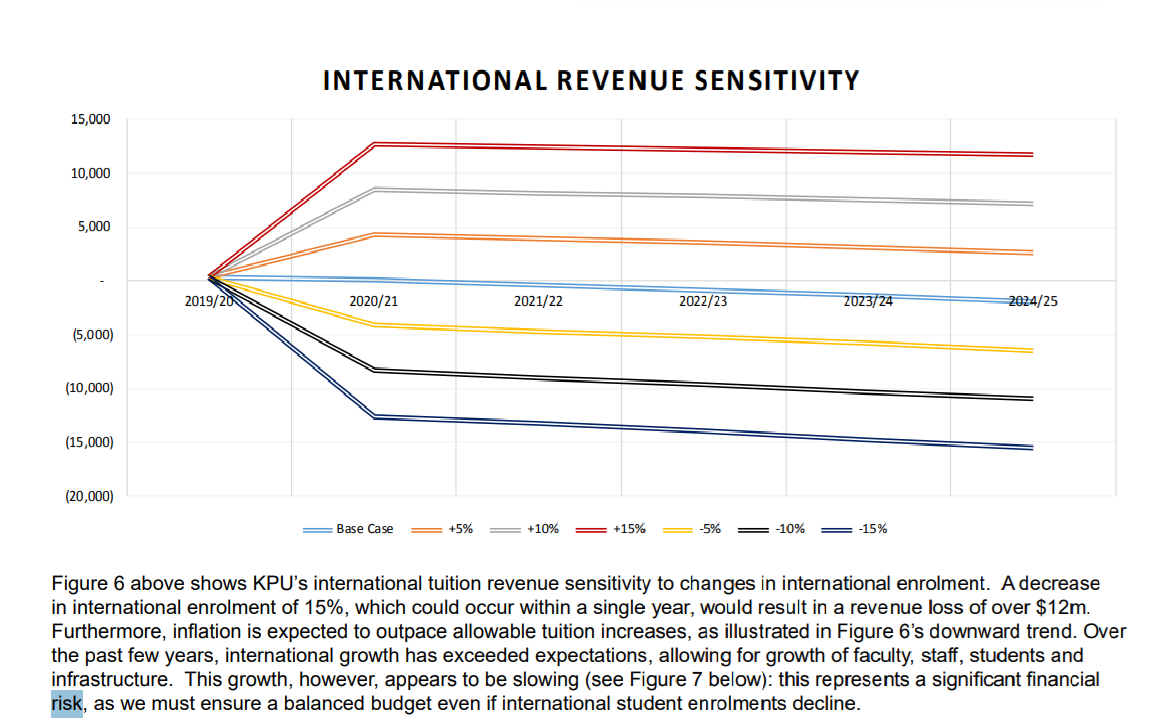
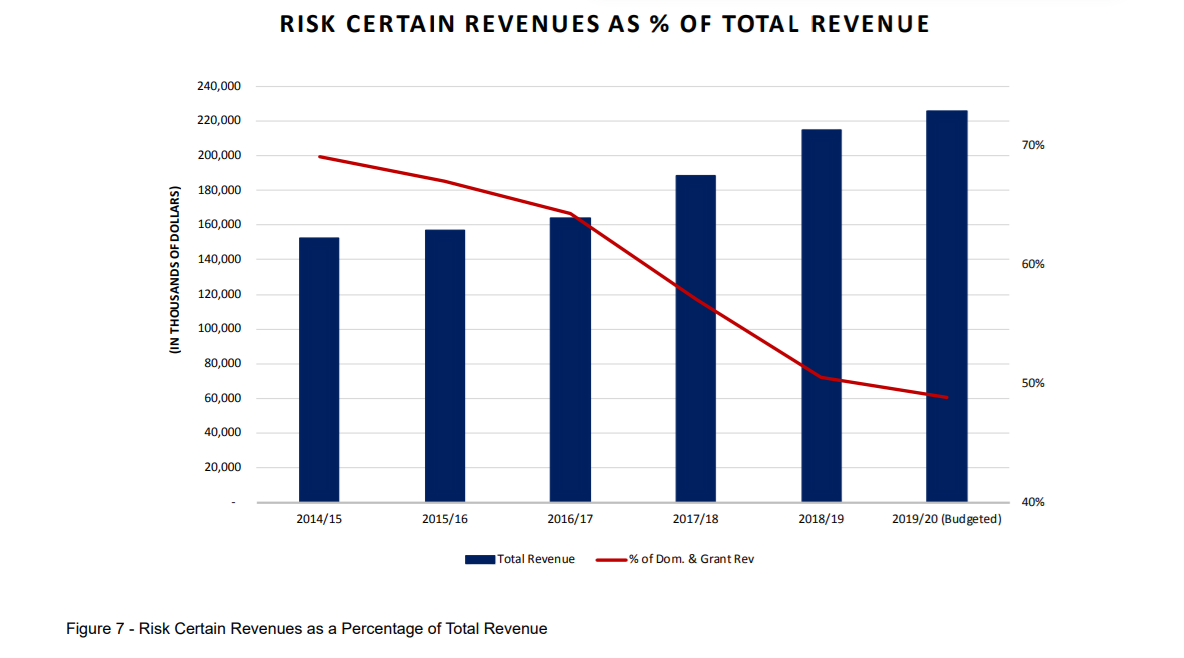
So, these administrators were well informed, quite some time ago. And yet they continued down this path, we would say recklessly, continuing to expand international enrollments in the face of this clear advice and clear presentation of risks.
This was the chosen path until the choice was taken out of their hands by force, and now students and faculty are paying the price.
But not administration. Administration, despite being increased out of line during this same period, is now being retained at a disproportionate level in comparison to the decreases in faculty.
Declining Proportion of Faculty and Increasing Proportion of Administration
I believe the membership well knows the KFA position regarding the imbalanced proportions of faculty and administration. Here is some specific data and discussion that illustrates our concerns.
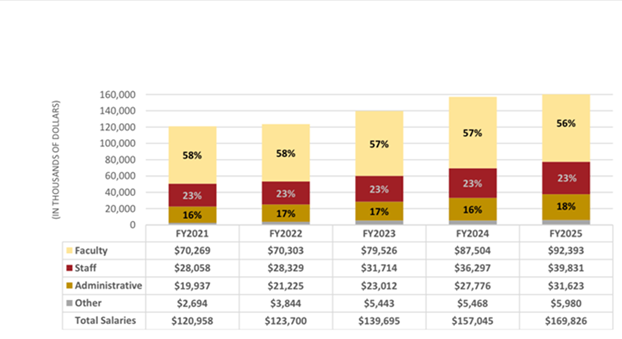
(From KPU’s Audited Financial Statement 2024-25 (the most recent available at this time): https://www.kpu.ca/sites/default/files/Finance/8.3.1%20Management%20Discussion%20and%20Analysis%20Year%20Ended%20March%2031%202025%20AC%202025-06-17.pdf
This graphically illustrates the growth of administrative salary as a proportion of total salary at KPU. From FY21 through FY25, administrative salary increased from 16% to 18% of total salary. At the same time, faculty salary declined from 58% to 56%.
However, this aggregated approach obfuscates the scale of year over year increases which show that in the four years from 2021 to 2025, faculty salaries increased 31% (increases fully funded by block grant, see discussion below) while administrative salaries increased 59%, close to double the increase in faculty salary. This chart illustrates this:
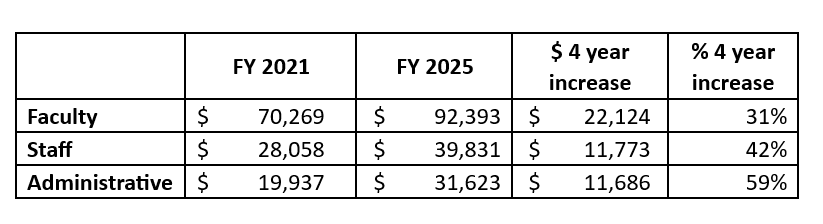
(NB: This does not include the disproportionate increases before 2021.)
Thus, even before the layoffs in FY26, faculty salary had already declined significantly as a proportion of salary at KPU. If reductions to salary are required, it would not appear as if faculty salary is the salary line that should be decreased.
Here is another way of looking at it. The data here below for faculty and admin FTE is drawn directly from the Human Resources Database (HRDB) which is maintained by PSEA, and for student FTE is drawn directly from KPU Accountability Plans and Reports.
No Proportionate Cuts to Administration
This graph here below shows the increase in FTE for Admin, Students and Faculty, in terms of a percentage of 2013 numbers. This year was chosen as it was just before the large increase in international student enrollments. By the year 2024, there was 86.17% more excluded FTE than there was in 2013. By contrast, there was only 13.01% more Faculty FTE than there was in 2013. This is quite clearly disproportionate.
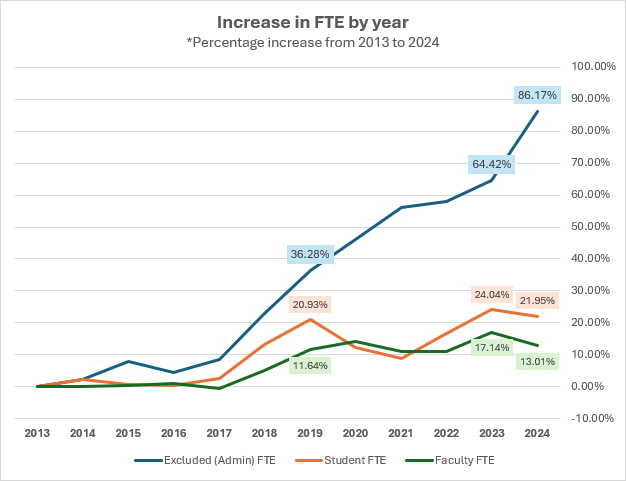
This graph is based on the following table drawn from HRDB data and for student FTE from the KPU “Accountability Plans and Reports” for each year (https://www.kpu.ca/opa/accountability-plans) :
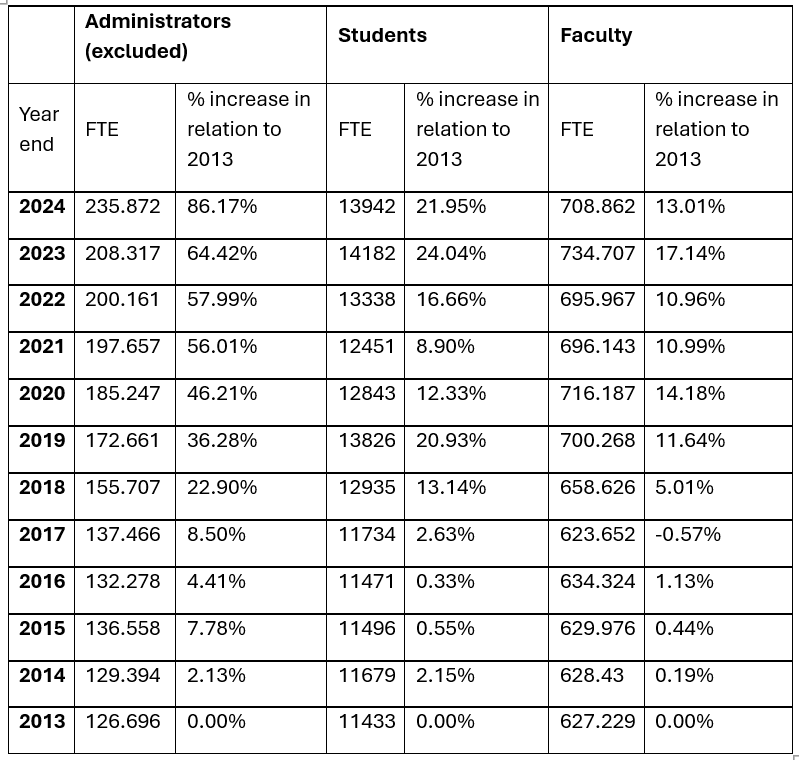
(NB: HRDB data is not publicly accessible but requires password login, so you would not be able to access it through a link. Please see attached a screenshot of one of the data tables.)
Necessary Reductions in Administrative FTE and Salary
The general notion on the part of the Employer is that the total salary budget must be reduced. Based on the admin projections, we estimate faculty FTE (which is conflated with non-KFA employees) will be at maximum ~658 or fewer FTE. At this faculty population, a reduction of at least an additional 50 FTE in admin beyond the planned decrease is necessary to achieve proportionality with faculty reductions. We estimate this would be approximately $8M in salary savings based on average admin salary per FTE. This righting of proportionality alone would more than offset the planned faculty reductions.
But it is not happening because in the words of the senior administrator to the faculty members in a layoff meeting, “We need to keep things that are important.”
Enrollments and Budget
The Employer is choosing to frame enrollments in a way that does not make logical sense to us to justify KFA member layoff, neither in terms of the institutional mandate nor in business terms. Most of all, it does not make any sense in terms of the structure of institutional revenue.
The Employer has stated the layoffs are “due to declines in international enrollment leading to declines in revenue,” without adequate information or support given for their position that this then necessitates faculty layoffs. It would be logical and rational to present explicit information around revenue from all sources including identifying a key feature such as the guaranteed full funding of faculty salary, then linked to numbers of enrollments overall in the institution, then linked directly to offerings in any particular discipline or program.
But the Employer has not presented any of this specific data to show clearly the necessity of removing 77 more regular faculty members and more non-regular faculty members from their employment. To cite a general projection of “enrollment decline” approximately 1 ½ years in the future is vague and nebulous. It is certainly too vague and nebulous upon which to base decisions that will cause such chaos and disruption to individual faculty members, to whole academic disciplines and programs, to the ability of faculty to be actively involved in the academic life of the University, and ultimately to the University being able to fulfill its mandate.
The Business Perspective
From a business perspective, the main driver of revenue is faculty, both in terms of tuition revenue as well as in the block grant revenue for faculty salary increases. Every layoff of a faculty member means fewer courses and sections are available for students, and this will exacerbate the already problematic situation in which students are not able to finish their credential programs or desired transfer credits in a reasonable period of time. This carries a risk of further reputational harm.
In addition, the revenue from the block grant associated with the full funding of faculty salary (see below for detailed discussion) is being imperiled. This is extremely unwise and a significant risk.
International student enrollments
The Employer states that declines in international enrollments necessitate faculty layoff. We say this is false on two fronts.
First of all, the Employer lays the blame for the situation on IRCC, but we believe this is a red herring. KPU is not meeting the quota set for new intakes, and so limitations placed externally are not at fault.
Also to consider: BC Government set a limit on Int’l students at 30% or lower, which was to take effect in AY25. (Note academic year, AY, and fiscal year, FY, are slightly different. AY is September-forward, and FY is April-forward. Both are named by the year ending the period, thus, for example, AY25 is the academic year ending August 2025; FY25 is the fiscal year ending March 2025. The fiscal year is the fiscal year of the provincial government; all public sector bodies have the same fiscal year.)
The recent global KPU proportion of international students during AY25, was 34%. For FY25 it was 38%. For FY26 it was 24%. The percentages in 2025 exceeded the cap, reflecting both poor enrollment management planning on the part of the administration, as well as poor fiscal management: administration was laying off faculty at the same time excess revenue from international enrollments was achieved.
The Block Grant and Faculty Salary Cost
The second front on which we take issue with the Employer’s position regarding international enrollments is that in addition to the above features regarding international enrollments, we say that the realities of the revenue through the block grant means this: international enrollments are not as significant to faculty salary cost as the Employer is claiming.
There are two significant issues with how the institution is administering the revenue from the government grant monies. One is in how it is using the funds that are targeted for developmental education. The other is in how it is administering funds that are meant for the full funding of faculty salary increases since the salary mandates started in 1993.
Developmental education
The approach being taken to developmental education funding is a direct risk to the institution.
Developmental education block grant funding reductions, according to a direct communication from the Ministry to the KFA, are only *to the level already actually provided* so cutting beyond this is not necessary. The amount currently delivered, including the faculty delivering the courses and programming, are still being funded.
Not only is it not necessary to cut developmental education but it is a direct risk to the institution. Faculty salary including salary for these faculty members is being fully funded to a great extent (see next section below) in addition to this direct funding to replace tuition. Thus, the developmental education offerings currently in place are amply funded already and do not require cuts to faculty.
This action is also a direct risk to the institution. The gov by this action has just very clearly indicated that they will not continue to allow the institution to take funding intended for one purpose and spend it on a different purpose. By cutting beyond what is already being fully funded to take developmental education below what is currently delivered, the institution thus will be very clearly diverting targeted funding intended for developmental education to other administration priorities. This is a risky action, and it might be seen as a flagrant disrespect to the Ministry.
Furthermore, by further reducing offerings in developmental education, the Employer is guaranteeing future grant reductions because the government almost certainly will reduce the funding further in response to the upcoming planned layoffs and cuts. This is a downwards spiral that only ends in the unsanctioned complete discontinuance of all of the programs. And, less importantly, it will result in the loss of all of that grant revenue. And for what?
These cuts are not warranted, and they are unwise.
Below, we will discuss how KPU is not meeting demand for developmental education in our region, but here we will continue to discuss problems with how the institution is administering the block grant.
Full funding of KFA Faculty Salary Increases and Institutional Risk
Please note well that not all of the block grant is for the full funding of faculty salary, but part of it is and this is explicit in the budget letter. (Please see above reference to the budget letter.) However, the institution is not spending all of this portion of the grant on its intended purpose, faculty salary.
This is a significant and needless risk. The institution is diverting a large proportion of the monies granted for the purpose of fully funding faculty salary to funding things that are not faculty salary. Just as grant monies were reduced as a result of not spending them on developmental education, the institution is risking having the grants reduced to a much greater degree through not directing monies properly for faculty salary.
Faculty salary, as the Employer well knows and which we have repeatedly reminded them, is already funded directly by the government to a great extent as a result of full funding of salary increases. The Employer acknowledged this in the recent budget meeting with KFA and Finance as well as in the layoff consultation meeting. In the consultation meeting, they cited a figure of 35%, but we believe their figure is not correct.
Block Grant Funding of KFA Salary
Why do we say this?
In every round of bargaining since 1993, KFA faculty salary increases have been fully funded by the gov through the block grant as part of explicit promises made during bargaining. Please recall the statement in the current budget letter that “funding for collective agreements ratified under the Shared Recovery Mandate” was added to the block grant. We gave up the opportunity to bargain higher wage increases in exchange for the assurances against layoff that are realized through having full funding of increases. At the time the mandates began, faculty salary was already funded at least in part, and the “fully funded” increases were on top of that part. This was viewed as a fair trade-off by the parties. However, that bargain now is being subverted.
Who is telling us the truth? The provincial government and PSEA through salary funding mandates? Or our KPU administrators? It cannot be both.
It certainly seems that monies we bargained explicitly as full funding of faculty salary are being diverted for other purposes, and KFA faculty are being laid off as a result.
How do we calculate this?
The following is a calculation heavily weighted in the Employer’s favour. It does not include the amount already fully funded as of 1993, which is the greatest error in favour of the Employer. Another error is that it does not weight salary steps below the top of scale. That is, there were significant increases to steps below the top of scale that went beyond the increase to the top of scale at certain points on this timeline, and those increases were also fully funded, but at a higher rate. That is not taken into consideration here, and this is in the Employer’s favour. Focusing here on tuition per credit negates the income from fees other than tuition, which further advantages the Employer’s position.
Furthermore, the relationship between faculty salary coverage on the one hand and enrollments on the other also declines over time due to the ongoing additions to full funding but it also declines because of increases to revenues other than block grant and tuition. It declines in terms of enrollments per faculty cost as a result of annual tuition fee increases, which for domestic tuition rates is set to increase in the upcoming year by 2%. This is again weighting these figures in favour of the Employer.
On the other side of the ledger, we are not calculating benefits costs. This is approximately 17% according to the Employer; it is what the KFA is charged for officer releases. One reason we are not incorporating this is that in some bargaining rounds, certain benefits also have been fully funded through the mandates, as in, for example, the 2022-25 round. Another reason is that we also believe the portion of benefits not funded directly should be significantly less than the features weighted in the Employer’s favour, especially the lack of consideration for the percentages already fully funded through the grant at the time mandated salary increases began.
Thus, this straightforward calculation, while still weighted in the Employer’s favour, is a clear and simple way of understanding the concept of full funding and addressing discrepancies in the use of the block grant.
What is the Extent of Full Funding?
Here is what our estimate of full funding looks like, at minimum:
- In 1993 top of scale was $62,836, according to the Collective Agreement current at that time (See attached – apologies, no direct link is available.)
- Our present day top of scale is $115,129. The percentage covered fully by the grant is thus at minimum ~45% until the end of fiscal 2025 (FY25).
- This percentage continues to increase with every subsequent raise, which we already know for the upcoming term is 3% per year, with additional monies to cover other expenses not yet determined.
- For FY26, the top of scale will be $118,583, so the percentage fully funded will be at least ~47%. Note we say “will be” because negotiations have not yet concluded. It is our understanding that the Employer will receive the full amount of retro once the Agreement is concluded and prior to paying it out.
- For FY27, the year in question for the upcoming planned layoffs, top of scale will be $122,140, so the percentage fully funded will be 48.5%.
- For FY28, the top of scale will be $125,805, so the percentage fully funded will be 50%.
- For FY29, the top of scale will be $129,579, so the percentage fully funded will be 51.5%. Assuming salary mandates continue, any future raises on this rate will likewise be fully funded and thus will decrease the percentage of faculty salary covered by other revenue.
The Figures for Tuition and Enrollments
First, terminology and bases for discussion:
- Fiscal year is the basis for budgeting, and it begins April 1, so the Summer semester is the rough beginning of the fiscal year
- Domestic enrolments are taken here as seats filled by domestic students
- Domestic tuition fees are set to increase by 2% in the upcoming fiscal starting Summer semester
- Tuition fees are paid by credit
- International enrolments are taken here as seats filled by international students
- The salary scales are laid out to indicate the salary for one full time faculty member, so in other words, they are the maximum cost for one FTE salary. One FTE faculty workload in credits is most commonly delivered as 8 x 3-credits courses, or 24 credits.
Tuition rates (current as listed):
- Domestic tuition per credit (as at Spring 2026):
- Category 1 (Standard Courses): $159.65 per credit, $162.84 after increase
- Category 2 (Specific Faculties/New Courses): $192.91 per credit, $196.77 after increase
Co-op Courses: $162.84 per credit, $166.10 after increase
- International tuition per credit not including ancillary fees (as at Spring 2026, not planned to increase):
- Standard courses: $740.95
- Co-op Tuition: $740.95
- ELST/ENGQ Courses: $410.08
FY27 Planned Layoffs and Full Funding
For FY27, the maximum salary for one faculty FTE is $122,140, and the amount not covered by the grant according to our generous calculation is thus $59,238 for this year.
Domestic Enrollments
- Domestic tuition fees category 1 after increase (lowest rate) @ 24 credits (one whole faculty FTE) = $3908.16
- $59,238 / $3908.16 = 15.16 domestic seats filled per section to fully cover faculty salary cost
- For the faculty body as a whole, then, average class size entirely domestic students to fully fund faculty salary is 15.16 domestic students.
- Seats filled by Domestic in FY25 = 139,885 (from the Employer’s Enrollment & Application Reports)
- Average seats filled by domestic students per class = 15.1 (from same source, the Employer’s Enrollment & Application Reports)
- Thus, domestic enrollments alone more than met faculty salary beyond the block grant funding.
- Domestic enrollments remained about the for FY26 and are projected by the Employer to remain the same or see a slight increase in FY27, per FY27 budget presentations.
- Domestic enrollments alone will continue to fund faculty salary.
International Enrollments
- International tuition fees normal rate
@ 24 credits = $17,782.8
$59,238 / $17,782.80 = 3.33 - Average class size entirely international students to fully fund salary is thus 3.33 students.
- Average seats per class int’l = 8.8, more than double the amount to cover faculty salary completely… but it is not needed.
A total of 35,919 seats were filled by international student enrollments. In revenue, assuming most seats are 3 credits, this is at least [($740.95 x 3) x 35,919] = $79,842,549.15 in excess of faculty salary costs for FY25.
Here are the specific figures:
Table 1: Seats Filled Annually (total enrollments domestic and international excluding Trades and CPS) for Fiscal 21/22 through 24/25
From “Seat Statistics Report by Academic Year” on KPU Enrollment Reports Dashboard found at https://app.powerbi.com/groups/me/apps/b60bda1b-1ab0-46f0-a090-4463508b8429/reports/403ca4a1-1292-4b57-85f7-51f055589cbf/ReportSection?redirectedFromSignup=1&experience=power-bi
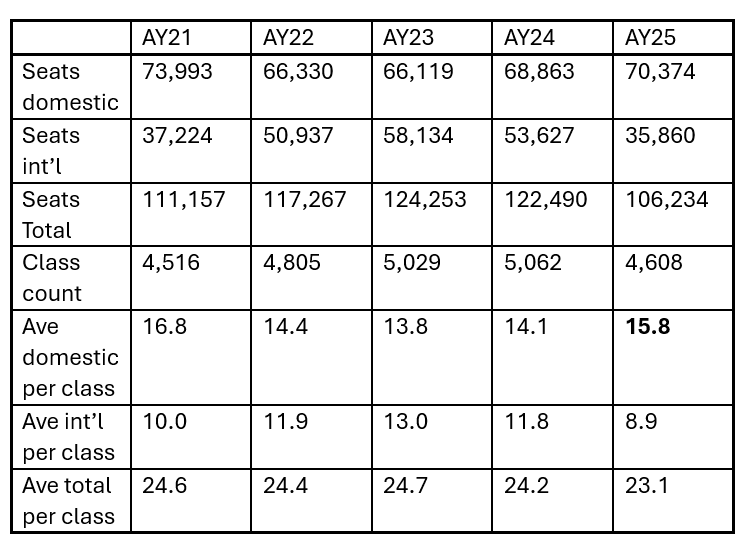
This report is based on the academic years, so that means the annual figures are not included past AY25 and do not include all of FY26. Because of this, we also used the semester reports under the Enrollment Tracking Report on the same dashboard. The figures are presented here below.
Table 2: Seats filled (total enrollments) domestic and international, excluding Trades and CPS, for Fiscal Year Ending 2026
Notes:
- The previous table was circumscribed around academic year while this one is around fiscal year, the same as the budget.
- Fiscal year (the annual budget cycle) begins April 1, thus Summer semester is the first “new” semester in the fiscal year.
- There are slight discrepancies in the data on the enrollment dashboards between selections for domestic taken separately, int’l taken separately, and the consolidated data for each semester. The data here is taken from the data for each selected student category (domestic or int’l) on the “Enrollments Dashboards” for each semester as there is a specific figure given separately for each, and not simply a differentiation by percentage of total.
- The data is limited to the Faculty categories and courses taught by KFA members; there are other categories such as “non-Faculty enrollments” which we did not include, and CPS, which we also did not include.
- Trades figures are not included here because full funding comes directly from Skilled Trades BC and can only be spent on Trades training.
- CPS enrollments are excluded here because only a tiny fraction are offered through bargaining unit work, thus have no bearing on KFA member layoffs.
- “Class count” is taken from the consolidated figures in order to reflect the total number of course sections taught by all faculty members, not including Trades. Some sections might be entirely domestic; some might be entirely international. Thus, taking the total of both is most accurate to reflect the total faculty delivery of sections.
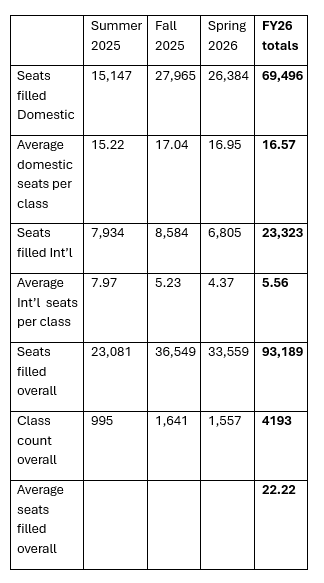
Thus for FY26, the domestic enrollments alone were even more clearly sufficient to fully cover faculty salary costs, and then some.
Lack of Clarity in Faculty Salary Budget Line
There is an additional problem in the Employer’s presentation of information regarding these layoffs and the justification presented before the Board for these layoffs.
The faculty salary line in the consolidated draft budget presented to the University community and to the Board conflated KFA faculty salary in the budget with other non-KFA employees, including contract researchers and CPS non-bargaining unit instructors, and a strange category called “non-faculty” under the enrollments data.
Thus, the figures we have been presented do not address the actual cuts in KFA faculty and the true proportion of the block grant that is being diverted. Given that the faculty salary line includes other employee groups, it is a safe assumption that we cannot use the KPU budget alone to calculate overall KFA member reductions. This is just part of the problems with the budget as it is presented.
Budgeting Decisions Rife with Issues
There are other issues with the budget. For example, last year, the administration budgeted approximately $13 million for contract faculty but did not spend this on faculty salary… while simultaneously laying off regular faculty members. This is now characterized as “budget rightsizing” by admin.
Here it is, from the budget presentation for FY27. Please look at the right-hand column:
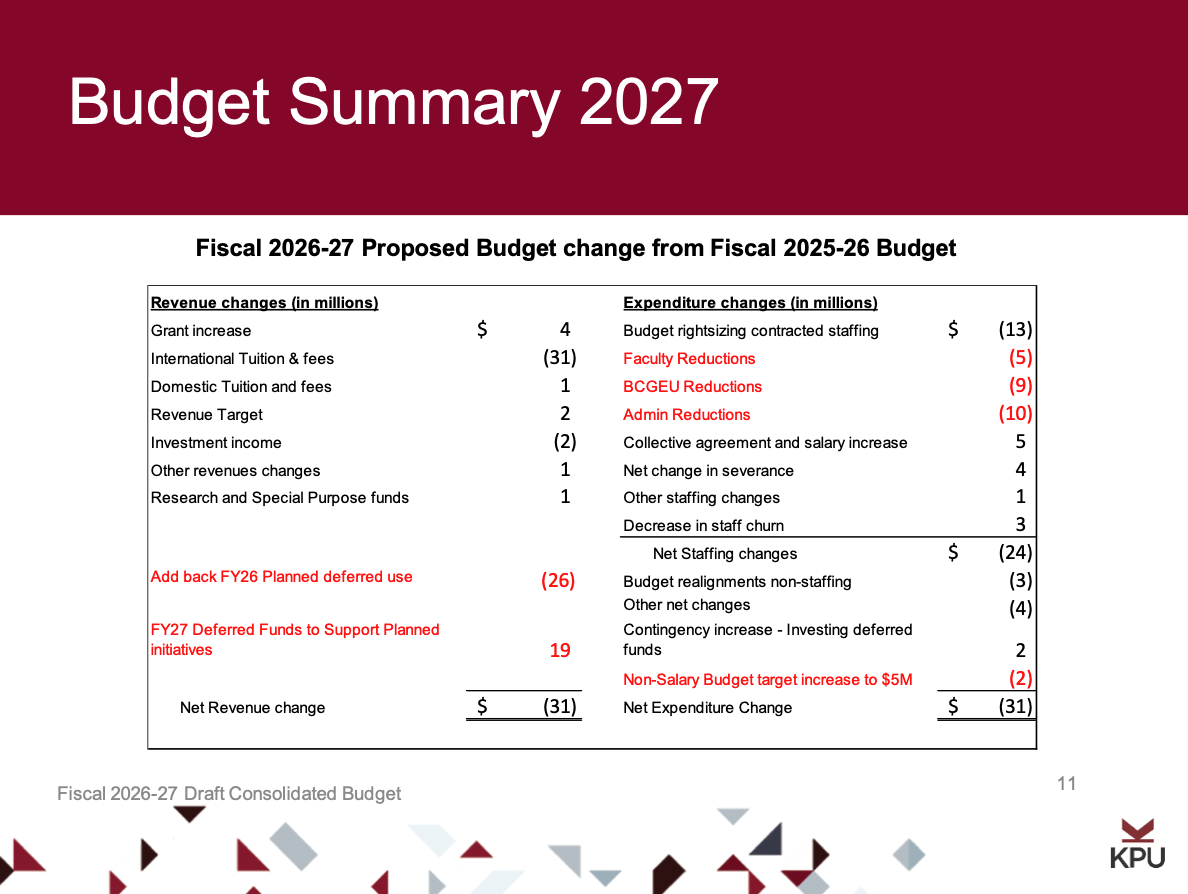
This is not only unreasonable, it also signals to us that there will likely be a massive surplus in the FY26 actuals, once they are finally made public.
This is part of the main issue with the FY27 consolidated draft budget being based on a draft-to-draft basis rather than an actuals-to-draft basis. Discrepancies are compounded between the actuals for FY25 and the draft FY25 which is the basis used for the draft FY26. Draft FY26, including these discrepancies, was used to create the draft FY27 budget. In other words, a set of unknowns/best guesses is used to create another set of unknowns/best guesses, decisions are based on this, and then another set of decisions is used to create a further set of unknowns/best guesses before the first set of unknowns/best guesses has been clarified.
Furthermore, the timing for taking the budget before the Board was puzzling. Normally, the upcoming FY budget has been taken before the Board in March or April, when the actuals for the year ending could be presented and incorporated into the presentation. The actuals for FY26 could certainly have been reasonably estimated at the time the budget for FY27 was taken before the Board, yet the estimates were not disclosed. Taking the FY27 budget before the Board could easily have been delayed until the actuals were confirmed, rather than this faulty approach.
And, again, all of the cuts in courses and programming for students and the resulting faculty layoffs are based on this faulty approach.
This is another example of critical actions being based on faulty priorities and faulty reasoning.
Not Meeting the Demand for Developmental Education
We will turn here to the Employer’s claim that KPU is “meeting the demand” for developmental education in our region. It is not.
We are aware of a number of fairly obvious facts regarding the situation in the region around developmental education. These are just a sample.
For example, for ELST, we know that LINC levels 5-8 (a federally-funded ELL program, not currently offered or funded at KPU) are being phased out. What this means is that there will be many students without seats, and it would seem rational that our ELST programs can quite easily fill seats for summer and beyond.
At just one LINC provider in Langley (New Directions), for example, we’ve been told that 150 students will be looking for classes as of April, and 500 more in September. We have confirmed with faculty that they worked together with that agency, and confirmed many students were interested in coming to KPU. They presented this to the Dean and the Provost together with a plan for transitioning the students, yet it was rejected, and the additional enrollments were rejected. They were told this could happen only if the corresponding number of their other sections (already full) were cut. There is community need, and students are interested in coming to KPU, and the Dean and Provost nixed it. Why?
For developmental education in general, we know that there is a large unmet demand in the Kwantlen region for adult upgrading.
For example, in Surrey, the Surrey School District runs a small adult education program, comprised of two learning centres, Invergarry Adult Education Centre and Queen Elizabeth Continuing Education Centre, both located in N. Surrey. Invergarry is a dedicated adult education centre that offers courses at all levels, and both day and evening programs. Queen Elizabeth offers Gr. 11 and 12 courses, only in the evenings.
They both accept domestic and international students. Domestic students pay no assessment fees and pay a $20 “student resource fee” upon registration. This is significantly less than the financial barriers these students face at KPU, and this is only one of the financial and process barriers KPU is creating.
As of March 2026, Invergarry Adult Education Centre has paused assessments due to a large number of students on their waitlist and is running a limited lottery for spring assessments.
From: https://www.surreyschools.ca/invergarryadulted/registration :
Assessments: At this time, due to the large number of students on our waitlist, we are postponing all assessments until April.
The assessment lottery will open on March 30 and close on April 2.
Assessments will begin on Monday, April 13 and end on April 23.
If you applied for the lottery in January and did not receive an email, we still have your names and you will be contacted by email. If you are successful in getting an appointment in this April round, you will be emailed.
You must be a Canadian Citizen, Permanent Resident, or hold a valid study permit or refugee papers.
We apologize for the inconvenience that this causes but for us to be able to offer you the best success in your education we need to ensure that there will be seats available in our school once your assessments are done. Thank you for your understanding.
Semester 2 Registration: Is now closed. [Feb through June].
Richmond and Langley school districts also run adult education programs that are likewise far more barrier-free and lower cost than KPU.
Administration Creating and Knowingly Maintaining Significant Barriers to Access
In 2024, in the context of planned layoffs in developmental education, the KFA provided a comprehensive discussion of developmental education and the barriers KPU is creating for developmental students.
These barriers still exist and have not been addressed, let alone removed. From that discussion:
An Easy Road to Increasing Domestic Enrollment
Our region is well-known to have unmet domestic needs in terms of participation rates in post-secondary, and likewise well-known to have under-prepared and under-qualified residents who could benefit from post-secondary education, but who have these and other barriers to entry. The Employer is not addressing these issues.
Upon consultation and examination of the practices of the Employer with regard to Developmental students, we find that there is a simple course to supporting access to programming at KPU and thus enhancing domestic enrollments.
The Adult Learning programs in the region’s school districts, especially in Surrey, have substantial waitlists, at the same time that KPU has made claims of declining student demand.
KPU charges developmental students a $40 non-refundable application fee which must be paid before they can have an assessment. There is a $250 confirmation deposit that is required before registering and which is applied to other fees, and full student association and other ancillary fees (all non-refundable). If there are textbooks, students pay for them. These comprise significant barriers to domestic students being able to enter developmental programming at KPU.
At the Adult Learning Centres, in contrast, all assessments are free. Students pay a single registration fee of $20 upon registration for courses. There is a single fully refundable textbook deposit for courses having a textbook; students do not need to buy textbooks. If a course has a workbook, it is provided free of charge. There are no other fees.
For English Language learners, there is in addition a Welcome Centre dedicated to them. This centre has language services as well as other support services designed to encourage students and reduce barriers.
It would be a simple matter for KPU to eliminate the barrier of the excessive fees it is charging developmental students, and increase enrollments and meet the mandated targets for developmental programming. We would suggest that establishing a Welcome Centre for developmental students likewise would help to reduce barriers and support students to enter KPU.
It is also well-known and supported by institutional data that successful developmental students persist and succeed at a higher rate than high school graduates. Increasing domestic developmental student enrollment is a win for the institution so far as student persistence, retention and success.
This set of conditions still exists.
There is a significant unserved adult population in Surrey that is trying to gain access to education. KPU is putting up unnecessary barriers to these students in the form of fees and process, and KPU has needlessly brought about the loss of the revenue for developmental FTE that could still be coming in to provide access to these underserved students.
The budget letter to KPU says, “Access to ABE, ELL and AET programs in the public post-secondary system is essential to British Columbians who want to pursue further education and training to obtain the skills they need to succeed in the jobs of tomorrow.”
This is not up to KPU administration to change at will, or to de-prioritize.
CPS: Is it “Cost-Recovery”? Or is it Funded by the Grant?
At the same time KPU is preventing access for citizens of our region, they are promoting, funding and maintain a CPS division. CPS is supposed to be cost-recovery in its current model. We don’t see how this is possible. Here is the current enrollment for CPS according to the enrolment dashboard:
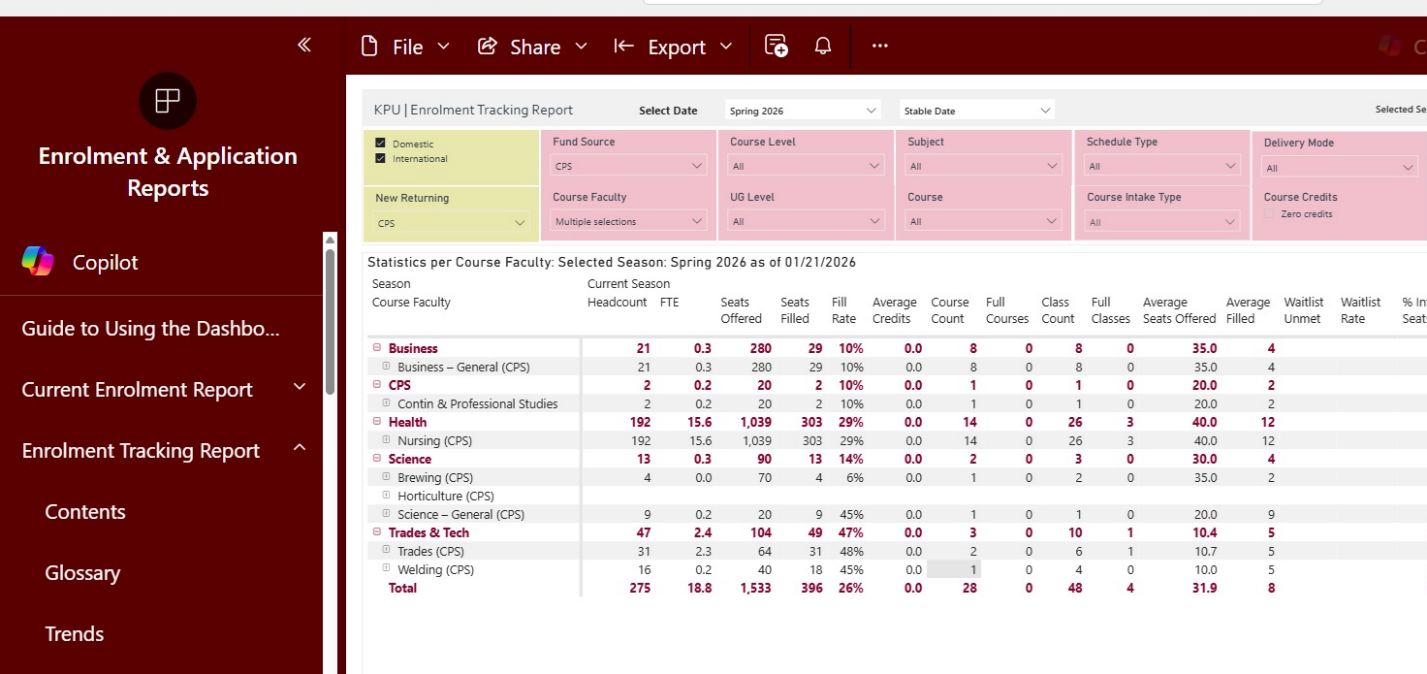
This enrollment is not sufficient to cover the costs of instruction and administration for CPS.
It appears that instead of being cost-recovery, CPS is being funded from the general revenue of the institution. Rolling CPS instructional and administrative costs into the general faculty and administration salary lines obscures the real cost of CPS. The administration refused point blank to provide these figures to the Union during bargaining and refused to detail CPS instructional costs during the layoff consultation.
This suggests that CPS is being funded not as cost-recovery but as a drain on the institutional resources, including monies that ought to be spent on KFA faculty salary under the block grant. Thus, CPS activity under the current model appears to be contributing directly to faculty layoffs. We pointed this out to the Employer in our consultation response on the layoffs. Their answer was as follows:
KPU has invested in Continuing and Professional Studies (CPS) to expand and diversify its revenue sources, not to divert resources from grant-funded academic programs. CPS also helps to attract new learners to the University, which supports overall enrolment and community engagement. These offerings are designed to cover the direct costs of instruction and contribute to shared University services. In addition, continuing education activities are consistent with the University’s mandate, and the University Act explicitly recognizes continuing education as a core power and duty of universities.
This response is obfuscatory. It does not address the concern, but states, “it is designed to cover,” and not that it in fact does cover costs and does not divert resources. The direct costs of instruction cannot be covered with these enrollments, let alone a fair share of “shared University services” which include a dedicated administrative unit.
As it happens, this administrative unit adds to the number of direct reports for the administer responsible, and higher numbers of direct reports results in a higher salary for the administrator responsible. This higher salary certainly is not covered by these enrollments. The direct costs of administering CPS also include, for example, excessive numbers of administrators in joint committee meetings. Each of the parties has three votes, and three KFA officers attend, but as many as 6 or 8 administrators have attended at times, and certainly more than three administrators always attend. This cannot be fully funded by those enrollments.
It is plain. On those enrollments, CPS cannot be and is not self-supporting, and it is diverting funds from other activities in the institution. This must cease.
Questions that remain outstanding / unanswered:
We have asked the Employer the following questions, some of them more than once, and we have yet to receive responses:
- What is the total for KFA member salary only, over the past 5 budget cycles? The “faculty” line in the budget is conflated with other employee groups. We need this information to be able to see clearly what the real salary reductions have been for KFA members. What is the total salary for CPS non-bargaining unit?
- What is the decline in salary over that period of time (5 budget cycles) for KFA members in proportion with student FTE?
- Why does the University not have a Strategic Enrollment Plan in place? Why was the plan to have one cancelled? They now seem to be claiming to have one, but we have seen and heard nothing on this front, and it certainly is not posted publicly or transparent to the KPU community.
- What is the student enrollment identified in the enrollment dashboard as “non-faculty” enrollment? This is not CPS. How can there be “non-faculty” student enrollment?
This is some of the data and information that is being withheld from the Union in the context both of the already executed and pending faculty layoffs as well as for bargaining.
Conclusions
To reiterate the general position:
There is no need for these layoffs now, and there was no need for the layoffs during this past year. All of these layoffs have been presented as necessary, but this is not the case. They are based on problematic and faulty priorities, and some problematic budgeting practices. The budget decisions that have resulted in section cuts and faculty layoffs are all a choice on the part of current administration, not a necessity.
Next Steps
Please attend the upcoming KFA Special General Meeting. Mark Diotte has sent out information regarding this meeting, and in that meeting we will be discussing and voting upon next steps and further actions available to us.
Please attend! Your attendance and participation will ensure a fulsome discussion and a clear outcome.
In solidarity,
Diane.
Second Call for Nominations for 2026 KFA Elections
Dear Kwantlen Faculty Association Members,
In accordance with Article 7 of our Constitution and By-Laws, this is the second call for nominations for the following positions on the KFA Executive Committee:
- President (until end of term, August 31, 2028)
- VP-Negotiations (until end of term, August 31, 2028)
- Member-at-Large (until end of term, August 31, 2028)
- Science & Horticulture Representative (until end of term, May 31, 2028)
- School of Business Representative (until end of term, May 31, 2028)
- Faculty of Health Representative (until end of term, May 31, 2028)
- School of Design (until end of term, May 31, 2028)
- Trades & Technology Representative (until end of term, May 31, 2027)
- Qualifying Studies & Access Representative (until end of term, May 31, 2027)
- Non-Regular Faculty Representative (until end of term, May 31, 2028)
- Status of Women Committee Representative (until end of term, May 31, 2028)
- Occupational Health & Safety Committee Representative (until end of term, May 31, 2028)
- Academic Governance Committee Representative (until end of term, May 31, 2028)
- Pension Advisory Committee Representative (until end of term, May 31, 2028
Please see the attached document titled “ Responsibilities of an Executive Committee Member” and By-law 4.2 for information about these roles. Please also see the new KFA Conflict of Interest Policy .
Nomination Period – March 23-April 14, 2026
The nomination period runs from March 23 to April 14, at noon. Nomination forms are to be sent to the Chief Returning Officer (C.R.O.), Diane Walsh. Three calls for nominations will be made during this time period. In the event that the call for nominations results in only one nomination being received by the close of the nomination period, the nominee shall be acclaimed at the Annual General Meeting on April 15, 2026. If there is more than one nominee, an online election will be held.
The nominations received to date are as follows:
| Nominee | Nominator | Position |
| President | ||
| Mark Diotte | Marc Kampschuur | VP-Negotiations |
| Member-at-Large | ||
| Science & Horticulture Representative | ||
| School of Business Representative | ||
| Faculty of Health Representative | ||
| School of Design Representative | ||
| Trades & Technology Representative | ||
| Qualifying Studies & Access Representative | ||
| Non-Regular Faculty Representative | ||
| Status of Women Committee Representative | ||
| Occupational Health & Safety Committee Representative | ||
| Academic Governance Committee Representative | ||
| Richard Le Grand | Kyle Matsuba | Pension Advisory Committee Representative |
If you have any questions, please don’t hesitate to contact me. You can find more information about the election process on our website.
Diane Walsh, Vice-President, Grievances
Officer Responsible for the Election
First Call for Nominations for 2026 KFA Elections
Dear Kwantlen Faculty Association Members,
In accordance with Article 7 of our Constitution and By-Laws, this is the first call for nominations for the following positions on the KFA Executive Committee:
- President (until end of term, August 31, 2028)
- VP-Negotiations (until end of term, August 31, 2028)
- Member-at-Large (until end of term, August 31, 2028)
- Science & Horticulture Representative (until end of term, May 31, 2028)
- School of Business Representative (until end of term, May 31, 2028)
- Faculty of Health Representative (until end of term, May 31, 2028)
- School of Design (until end of term, May 31, 2028)
- Trades & Technology Representative (until end of term, May 31, 2027)
- Qualifying Studies & Access Representative (until end of term, May 31, 2027)
- Non-Regular Faculty Representative (until end of term, May 31, 2028)
- Status of Women Committee Representative (until end of term, May 31, 2028)
- Occupational Health & Safety Committee Representative (until end of term, May 31, 2028)
- Academic Governance Committee Representative (until end of term, May 31, 2028)
- Pension Advisory Committee Representative (until end of term, May 31, 2028
Please see the attached document titled “ Responsibilities of a Executive Committee Member” and By-law 4.2 for information about these roles. Please also see the new KFA Conflict of Interest Policy .
Nomination Period – March 23-April 14, 2026
The nomination period runs from March 23 to April 14, at noon. Nomination forms are to be sent to the Chief Returning Officer (C.R.O.), Diane Walsh. Three calls for nominations will be made during this time period. In the event that the call for nominations results in only one nomination being received by the close of the nomination period, the nominee shall be acclaimed at the Annual General Meeting on April 15, 2026. If there is more than one nominee, an online election will be held.
If you have any questions, please don’t hesitate to contact me. You can find more information about the election process on our website.
Diane Walsh, Vice-President, Grievances
Officer Responsible for the Election
Update on Pending Layoffs
Dear Colleagues,
This past Friday, the Employer confirmed for us that they have rejected each and every one of the consultation proposals we submitted to prevent their planned layoffs.
This week, 79 faculty members have been called to 6 group meetings on Tuesday and Wednesday, and they each will receive a notice of layoff. In addition, four NR2 faculty members will be laid off. It is ironic that while in a recent message the Interim President urged faculty to respect their colleagues’ right to privacy around their employment situation, the Employer is not holding individual meetings to uphold that same right.
These layoffs impact faculty across a number of areas including ACP (English Upgrading and English Language Studies), Arts (a number of disciplines), Business (highest number of layoffs across a number of disciplines), and Science (a number of disciplines). Some of the disciplines are the same as were targeted for previous layoffs, and some are newly affected.
The KFA is taking all actions possible to avert as many of the layoffs as possible, and we will continue to speak truth to those with the power to stop these layoffs.
We will say again, clearly: These section and program cuts and the resulting layoffs to faculty are not necessary. They are a choice amongst a variety of different alternatives.
Please watch for an expanded communication with more detail on this topic, and other communications including ways you can help.
In solidarity,
Your KFA Officers:
Mark Diotte
Marc Kampschuur
Diane Walsh
Rachelle Hollaway
Rebecca Yoshizawa
Carlos Sandoval
FY27 Budget Impacts on KFA Members
Dear Colleagues,
Your Union has become aware that more layoff announcements are on the horizon, and while we are now engaging the Employer in the conversations mandated by Article 7 of our Collective Agreement (Layoff and Recall—Regular Faculty), we have also become aware that these layoffs were planned by the Employer as early as May 2025. This omission is compounded by irregularities in the handling of the 2026/27 budget as well as problems with the budget itself.
Here is an overview of our concerns:
Transparency
- The Employer plans to cut 43% of faculty salary for developmental education (Qualifying, Upgrading, and ELST), including elimination of developmental offerings in Math and Science. However, none of these cuts are necessary. The KFA received confirmation from the Ministry that KPU will receive funding to cover the offerings currently being delivered.
- Normally, the University budget is before the Board in the March meeting for approval. This year, it was before the Board in January, despite objections from Board members. We believe that the timing of the budget was intended to circumvent consultation and debate of the budget. Furthermore, it was known that the Board Vice-Chair and the University President would be absent, and it was known that the vacant faculty representative to Board and vacant student representative seat would be filled in March.
- The KFA had only one one-hour meeting with University Finance five business days before the budget was taken to Board. This meeting was solely to receive information from Finance; none of our questions were answered, and we were unable to provide input on the budget. The KFA has filed a grievance on the failure of the administration to consult with the KFA as is required on both these matters. We believe this grievance will be successful.
- The format of the budget documents is now less transparent than it used to be. Budget documents used to show a detailed breakdown of the budgets for each administrative and academic unit. Now, totals for these units have been amalgamated into one line entries, making it impossible to see how funds are being allocated and how these allocations impact our members.
- The budget conflates KFA faculty members’ salary with non-bargaining unit employees (contract researchers and CPS non-bargaining unit instructors). As a result, the “faculty” budget line does not indicate the changes to budget allocation for KFA members versus non-union employees. Once again, this makes it difficult for us to discern budgetary impacts on our members as well as changes to non-bargaining unit work. The Employer has not responded to KFA requests to provide a breakdown of these different categories except to say, “salary related to instruction is not presented this way.”
- The University community typically receives a report on actuals shortly after the end of the fiscal year. However, the KFA has been told by the Employer that actuals will not be available until sometime after June 24th. This will impede our ability to effectively advocate for faculty.
Concerning Elements
- $3.8 million in direct faculty salary reductions were approved for FY26, but $6.4 million in faculty salary reductions have been enacted—nearly double the amount approved. The Union has repeatedly warned the Employer that the cuts exceeded the approved amount, but they have ignored these concerns.
- The FY27 budget is not based on actuals but on draft-to-draft-to-draft projections. This is significant because it leads to the compounding of errors. The FY26 budget was based on the FY25 draft budget, not actuals. The FY27 budget was based on the FY26 draft (which was itself based on a draft). The FY26 actuals are going to be well out of line with the FY26 draft, and so the draft budget for FY27 is based not on facts but on a series of dubious projections, and it certainly will not be accurate.
- The consequences: The projected faculty layoffs are not based on facts or observed real necessity. FY25 actual figure for faculty salary was $92.392M. The real reduction for FY26 was $6.411M, not $3.8M, so actual salary for FY26 will be significantly lower than what is shown in the draft. So, for FY26 draft, we are starting at an already inflated figure, and the actual faculty salary figure is actually much less. The draft FY27 budget starts out with an expense for faculty salary that is artificially inflated above the true figure, so the “correction” in the form of cuts to faculty is far too high. We estimate that the true total faculty salary line (which we can all check when we eventually see actuals for FY26) for FY27 will be ~$74M or less, not ~$80M.
- A concerning line in the budget summary, called “budget rightsizing contracted staffing” totals about $13M. When we inquired about this line, the Employer explained it represents funds “reserved for non-regular faculty salary but not spent.” In other words, a significant sum was allocated to non-regular faculty salary while regular faculty were being laid off. None of this money was spent to prevent the layoff of regular faculty. We suspect that as a result of the budget rightsizing contracted staffing” amount, there likely will be a significant total surplus for FY26, well over the $5M originally projected by the CFO during the “Listening Tour.”
- The Human Resources Database (HRDB), maintained by the BC Government’s Post-Secondary Employers Association (PSEA), shows that “casual” faculty salary at KPU increased from $1.34M in 2024 to $3.02M in 2025. “Casual” is defined as those earning less than $3800 per annum. This is likely CPS non-bargaining unit contracts, suggesting that the Employer is reducing regular faculty work while increasing precarious work for KFA members by increasing non-union instruction.
No Proportionate Cuts to Administration
We have long been concerned about the growing disproportionate ratio of administrators to faculty and students.
This graph shows the increase in FTE for Admin, Students and Faculty, in terms of a percentage of 2013 numbers. By the year 2024, there was 86.17% more excluded FTE than there was in 2013. By contrast, there was only 13.01% more Faculty FTE than there was in 2013.
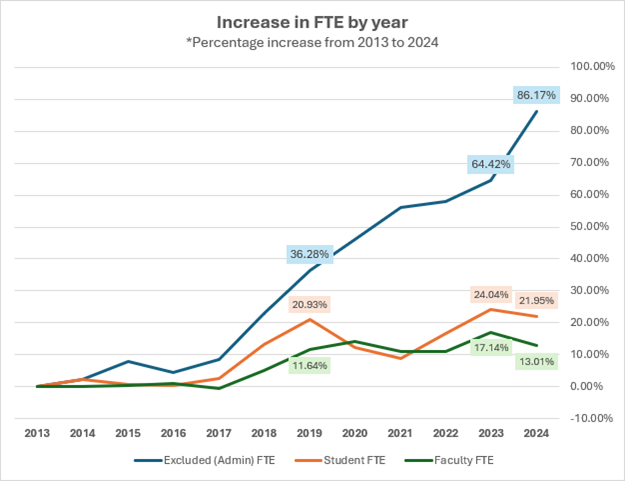
This graph is based on the following table drawn from HRDB data:
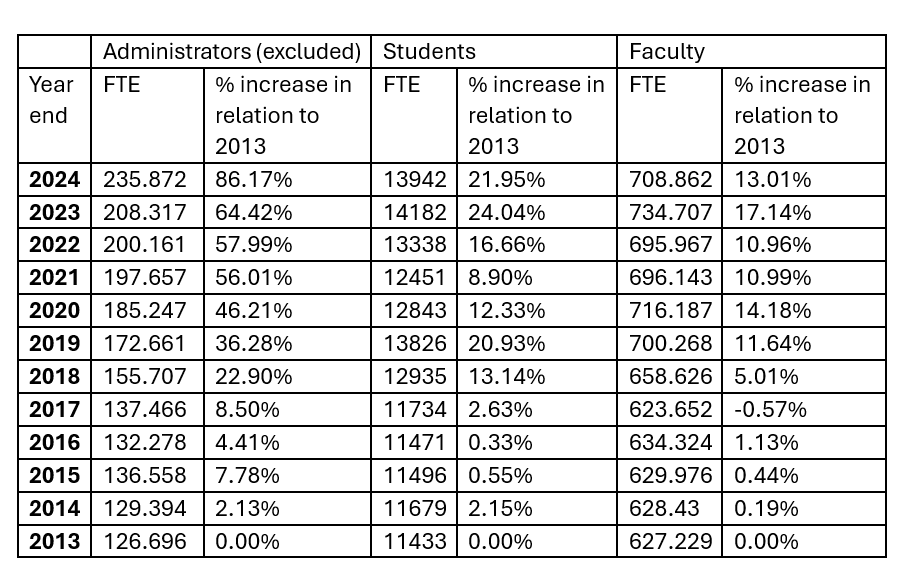
Based on the admin projections, we estimate faculty FTE will be at maximum ~658 or fewer FTE. At this faculty population, a reduction of at least an additional 50 FTE in admin is necessary to achieve proportionality with faculty reductions. We estimate this would be approximately $8M in salary savings based on average admin salary per FTE.
In Summary
The employment implications of the budget are significant for faculty. There appears to be an intention to reduce regular faculty work while increasing precarious work for KFA members, and to increase precarious work outside of the bargaining unit, and at the same time, to maintain or increase administrative density
We will be exploring these issues further in our meeting tomorrow to discuss faculty confidence in senior administration.
In solidarity,
Diane.
Update on KFA Layoff Consultation and March 3 Special General Meeting
**Note: since the publication of this article the Employer has adjusted the effective date of layoff to August 31st
Dear KFA Colleagues,
I am writing to update you on the layoff consultation process and related developments as well as to encourage you to attend the KFA Special General Meeting on March 3rd.
Layoff Consultation Process **
On February 11, 2026, the Employer contacted the KFA to schedule a consultation meeting regarding anticipated layoffs, and this meeting occurred on February 24th, 2026.
Yet, KPU published budget documents in May 2025 that identified “reducing budgets and the number of employees at the university” as a primary challenge. Between May 2025 and February 2026, KPU administration communicated expected layoffs through presentations to Senate subcommittees, Senate, and the Board of Governors, as well as through Communicator messages to the University community. In other words, KPU administrators produced budget documents and communicated expected layoffs to governance bodies for over nine months before initiating consultation with the KFA in regard to faculty reductions.
The KFA’s position is that the Employer was required to consult with the Union “as soon as known” under Article 7.01 of our Collective Agreement which would have been far in advance of February 2026, and, legally, such consultation must occur prior to any decision having been made on either the budget or the layoffs. The KFA has filed a grievance regarding the Employer’s compliance with the KPU-KFA Collective Agreement.
This is not the first time these senior administrators have failed to meet consultation obligations under the Collective Agreement.
In a recent arbitration decision, Arbitrator Randy Noonan found that the Employer violated its duty to consult when it “contractually bound itself to a process” before initiating consultation with the KFA. The arbitrator noted that consultation must occur before the Employer commits to a course of action and ordered the Employer to pay the Union $5,000 for violating its duty to consult—a rare financial sanction demonstrating the seriousness of the breach.
Dr. Diane Purvey, then Provost and VP Academic, and Jenn Harrington, then Senior Manager Labour Relations, heard this grievance at Step 3 and were responsible for the Employer’s Step 3 grievance response. Further, in this specific case, it was Jenn Harrington who was named in the arbitration in connection to the consultation process with Mark Diotte of the KFA.
Despite this prior ruling against KPU, the current layoff consultation follows the same pattern: KPU documented its intent to reduce employees in May 2025, presented layoff plans to governance bodies, announced layoffs publicly, and only then contacted the KFA in February 2026.
Both Dr. Purvey and Ms. Harrington have since been promoted to their current positions as Acting President and Interim Vice President Human Resources, respectively, and the budget and layoff consultation process has occurred under their direction.
Effective Date of Layoffs
The Employer’s February 18 Communicator message conveyed that any layoffs would be effective August 28, 2026, as it stated that retirement incentive applications must be connected to layoff mitigation through retirements on or before August 28, 2026.
Historically, effective dates of layoffs at KPU are September 1 for the Fall term. The KFA believes that the August 28 date may have been chosen to create a loss of FTE for affected faculty, that the selection of the August 28th date may reduce severance entitlements by one month (for those for whom August would complete their appointment year), and may further reduce the ability of some members to progress to a new salary scale step.
The KFA has asked the Employer to reconsider this effective date and are awaiting a response.
Provincial Funding Cuts
One aspect of the anticipated layoffs is purported Provincial funding cuts. KPU informed the KFA that the BC Provincial Government will reduce funding to Adult Basic Education (ABE) and English Language Learning (ELL) programs by 43% effective for the 2026-2027 fiscal year.
In response to these cuts, KPU plans to reduce English upgrading and ELL course offerings and discontinue courses in Biology, Chemistry, Physics, and Mathematics effective September 2026.
The KFA has contacted the Post-Secondary Education and Future Skills Ministry and local MLAs for confirmation of the funding reduction but is aware of no response to date.
What the KFA is Doing
- Advocating for reconsideration of the August 28 effective layoff date
- Engaging with the Ministry of Post Secondary Education and Future Skills and MLAs regarding provincial funding cuts
- Preparing to support affected members through the consultation and mitigation process
- Filed a grievance regarding consultation process violations
- Holding a SGM to discuss confidence in KPU senior administration
Special General Meeting – March 3, 2026
The KFA will hold a Special General Meeting on Tuesday, March 3 to address concerns raised by faculty members about confidence in KPU senior administration’s ability to govern the University.
While KPU’s new president commenced his term in September 2025, his current status remains unclear. The senior administrators who were the subject of faculty concerns under the previous president are now acting in higher positions.
Your participation and voice at this meeting are critical. We look forward to hearing from membership.
In Solidarity,
Mark Diotte
President, Kwantlen Faculty Association, president@yourkfa.ca
