


Manufacturing Precarity: Grievances Report Fall 2026
Good day, colleagues.
I hope that the new semester is treating you and your students well so far.
Please see here and attached my interim grievances report, submitted before the Fall General Meeting. I will provide a more comprehensive report before the Annual General meeting in Spring. (and please forgive any unintentional formatting oddness resulting from pasting a Word document into an email!)
To say that there is a lot happening in the VP Grievances portfolio is an understatement, to put it mildly.
I believe that a great deal of what is happening is part of a push towards increasing faculty precarity, including
- the excessive layoffs,
- the threats of more layoffs,
- the program discontinuances and the threats of program discontinuances, and
- other actions which I will describe below.
Given the widespread nature of the actions, it would seem a rational conclusion is that this is a deliberate strategy being enacted by the administration.
This has resulted in a wide variety of formal grievances around disputes which the admin has demonstrated no interest in resolving, further evidencing that there is a broad push to increase faculty precarity.
What are grievances?
First, a brief note for those who are not familiar with the general concept of grievances:
Grievances and grievance processes are described and outlined in the Collective Agreement in Article 17 Dispute Resolution. As the name suggests, the goal of this part of the contract is to resolve disputes between the parties (the KFA and the Employer are “the parties”). The KFA always tries some version of informal resolution first, and then if the problem is not resolved, then we file a formal grievance, naming and describing the dispute and naming and describing the exact articles of the Collective Agreement and/or employment related legislation that we believe have been violated.
An important note: Grievances are not necessarily to be considered “bad” at all; grievances are dispute resolution. Dispute resolution, a grievance in other words, is an opportunity for the parties to share perspectives and facts, and an opportunity to come to shared understanding of our common interests, and an opportunity to achieve resolution that will address the problems identified. Where this becomes problematic is where one of the parties seems to have little or no interest in resolution of specific matters or in resolving problems more generally. This is, unfortunately, the situation we are currently labouring under with current senior leadership.
General Outlines of Current Grievances
Thus far in 2026, the KFA has filed 105 grievances. Yes, not a typo: one hundred and five formal grievances. Most of them are, as you might imagine, related to layoffs in one way or another. There are a number of other topics, and I will speak to them as well.
Manufacturing Precarity
As I mentioned, most if not all of the current grievances can be viewed as part of a push on the part of administration towards increasing faculty precarity, and/or increasing administration’s ability to exert control over faculty.
And I would add that a consistent refusal to work constructively to address grievances is in itself a strategy to increase precarity by making our workplace less predictable and more unstable.
What is Employment Precarity?
Employment precarity results from the knowledge, feeling or belief that your employment is precarious, or in other words is insecure. When people feel or believe they are insecure in their employment, their behaviour often changes as a result. In an employment situation, they may, for example:
- stop exerting themselves for “the team”
- seek additional employment
- become increasingly stressed and distressed
- seek ways to ingratiate themselves
- be more willing to throw others under the bus
- stop speaking up
- stop taking initiative
- be willing to work more for no more compensation
- be less willing to demand their rightful working conditions
Precarity thus functions both to foster negative responses to our workplace and our colleagues, and it also fosters a reluctance to exercise our collective resistance to excessive authority.
There are many, many scholarly and popular sources for information on how employment precarity impacts people in their workplaces.
For discussion on precarious employment and its effects, see for example https://www.policyalternatives.ca/news-research/precarity/
And
“The Precariat: The New Dangerous Class.”
Manufacturing Precarity by Refusing to Resolve Issues
During this past week, I had occasion to meet with a group of people from across the institution, and I raised with them the fact that from about 2005 up until 2018, the KFA filed on average about 8 grievances per year, but since that time, more and more and more formal grievances have been filed, and most have remained unresolved short of arbitration. They seemed to be quite shocked.
From 2019 forward, numbers of formal grievances have escalated dramatically. Here are the numbers from recent years (and please know that the previous decade between 2005 and 2015 show similarly low numbers of formal grievances):
- 2015: 8
- 2016: 7
- 2017: 9
- 2018: 9
- 2019: 14
- 2020: 21
- 2021: 21
- 2022: 32
- 2023: 40
- 2024: 23
- 2025: 95
- 2026: 105 and counting
What happened in 2018? The Employer initiated a new HR division called “Labour Relations” which as the evidence shows seems to have the primary purpose of opposing dispute resolution.
The KFA continues to take the approach that disputes are opportunities, and we continue to seek informal resolution, but there is little or no opportunity to meaningfully address disputes under the current administration.
How does this increase precarity? When disputes go unaddressed over long periods of time, an unhealthy environment is created in which people are facing uncertainty around their working conditions, and this may bring about a sort of cognitive dissonance due to knowing they have certain rights and yet those rights are denied.
We are working towards being able to bring grievances to arbitration more quickly, and it is a work in progress. In the meantime, the Employer’s intractability and outright refusal to resolve disputes and follow the letter and spirit of the KPU-KFA Collective Agreement has created an unstable and unhealthy working environment.
Manufacturing Precarity: Faculty Layoffs
One of the most apparent and egregious ways in which faculty precarity has been actively increased has been through the ongoing and repeated rounds of layoffs of faculty.
In 2025, the KFA filed grievances on behalf of each and every faculty member issued layoff notice, as well as a general or “policy” grievance for all violations during each of the rounds of layoffs. There were 78 of these filed, which leaves 17 on other topics.
In 2026, 83 individual grievances have thus far been filed on behalf of individual members issued layoff notice as well as the over-arching policy grievances on behalf of the groups of faculty. There are 21 grievances so far on other topics.
Over this period, 161 regular faculty members received layoff notice. This means approximately 20% of regular faculty have received partial or full layoff notices during this period.
While numbers of these have been rescinded or reduced, is it not apparent that receiving layoff notice is a clear and simple means by which to ensure faculty members perceive their employment to be precarious. And then to threaten still more layoffs, in a vague and unclear way, and with no consultation with the Union, further heightens the perception of precarity of employment.
The Layoffs Have Been Inappropriate and Unwarranted
Discussion of the Union’s opposition to these broad scale layoffs and discussion of the grievance topics for individual and general layoff round grievances have been quite thoroughly examined in previous communications, so I won’t go over these in detail; suffice it to say, we do not believe the Union has been appropriately consulted on any of the layoffs, we do not believe the layoffs have been properly justified, and we do not believe that the bulk of them are warranted.
We believe that the reductions in faculty complement that may have been necessary have quite likely been covered off by voluntary departures through ERIP and severance, as well as involuntary reductions in non-regular faculty positions. We have, as I said, thoroughly discussed the reasoning for that and will not repeat it all here.
I do want to briefly highlight some pieces which you may not be aware of:
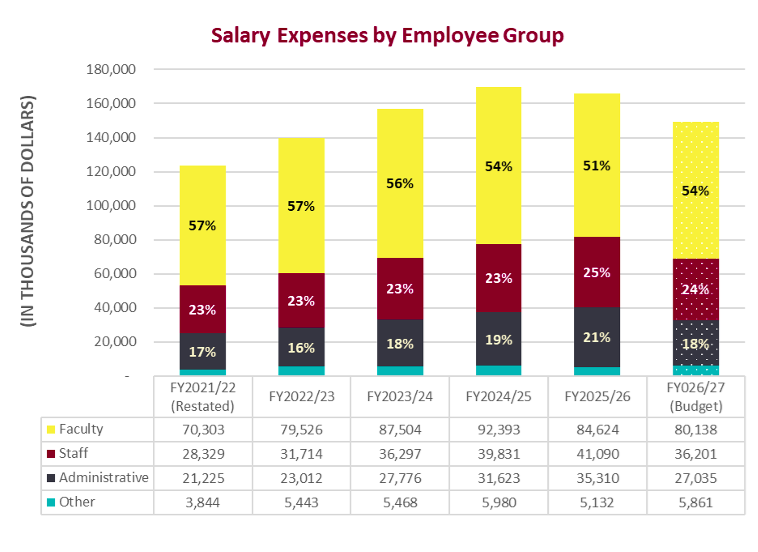
- During the 2025 fiscal year (FY25 – April 1, 2024 through March 30, 2025), there was a 13.8% increase to admin salary, and an overall $5M surplus, according to the FY25 budget report made to the Board. Admin salary increase was more than twice faculty salary increase in this fiscal, 5.5%. Note that “faculty salary” includes non-bargaining unit CPS salary. Also note that nowhere in the discussion is the fact that the increase to KFA members’ faculty salaries was *fully funded* in the gov grants.
- According to the audited financial statements for FY2026 (April 1, 2025 to March 30, 2026), administration salary increased by another 11.7%, and there also was a surplus, $500K, for that fiscal year. During this year, faculty salary decreased by 8.4%. Again, the gov grants are not itemized anywhere in the statements. Because the gov grants directly cover all salary increases and have since 1995, the decrease in faculty salary also hit the gov grant revenue line, and this is not acknowledged or noted. Note well: The Employer already knew these facts at the same they announced still more cuts in sections and more faculty layoffs in January 2026, and when they subsequently issued 83 more faculty layoff notices towards the end of March.
- For FY27, (noted in the FY26 audited financials) the planned decrease in admin salary is 23.4%, and I note we are over halfway through FY 27 (it begins April 1, 2026), and as of yet we have seen no layoffs of administration. But as we all know, we certainly have seen more faculty layoffs. The planned total decrease noted in the audited financials in faculty salary is another 5.3%, but we have been told directly the decrease will be 13%, so this is strange.
If we look at a longer time frame, from fiscal 23 through fiscal 27, the total budgeted increase in administration salary is 17.5%, including the . Note well that massive additional disproportionate increases in administrative salary and FTE occurred from FY18 through FY 23.
From fiscal 23 through fiscal 27, the total budgeted increase in faculty salary is 0.77%. Yes, that is correct: virtually the same total faculty salary as in FY23; however, because there have been salary increases for individuals in each year (fully funded salary increases) there is a significantly smaller FTE of faculty.
Here is the chart taken directly from the report to the Board, p 15:
It is passing strange that
- there is a claim that administration has been reduced, when it clearly has grown significantly and disproportionately since 2018, and last year increased by 11.7%
- there is a budgeted decrease forecast for administration in FY27, but past the halfway point through the year, no administration layoffs have occurred
- the only group of employees that produces significant revenue, namely faculty, has been the group being most heavily targeted for layoffs
- a significant source of institutional revenue is the operating grant portion that directly covers a large proportion of faculty salary under the fully-funded province-wide salary mandates; the Employer is well aware of this fact and that if they cut faculty, they are cutting the grant… yet they persist in cutting faculty and persist in calculating costs/revenues without including this fact
- many other institutions in BC facing the same difficulties around enrollment revenue are running approved deficits so as to soften the impacts, yet KPU admin continues to claim they cannot
- domestic enrollments are increasing, but the administration continues to claim that domestic enrollments are insufficient to cover institutional costs… yet not so long ago, KPU had approximately the same number of domestic students and somewhat fewer international students, and turned a surplus
It is all quite puzzling, is it not?
Manufacturing precarity: admin actions during the layoffs
As well as the general violations of imposing excessive layoffs, the Employer also is failing to properly apply the terms of the KPU-KFA Collective Agreement (the CA) in “Article 7 Layoff of Regular Faculty Members” around what must happen for faculty during layoff processes. All of these increase faculty precarity.
Here is a summary list of those:
- refusing to minimize layoffs by
- refusing to follow all of the mitigation strategies under Article 7.10 including those listed as not subject to funding
- refusing to follow the plain language around the voluntary severance provisions so as to ensure the amount of severance offered would be the amount for the member volunteering to take severance; this resulted in multiple members declining to take voluntary severance
- refusing to properly consider work in the upcoming year to mitigate layoff and instead re-employing regular faculty as non-regular faculty, in one instance offering an NR2 before the layoff even took effect
- refusing to consider, even temporarily, using available CPS non-bargaining unit work to mitigate layoffs – there are a number of faculty who were laid off and who are now or have been performing work in their subject area as CPS non-bargaining unit work, including in business offerings and ENTA-related offerings
- asserting a new interpretation of “ongoing” work as “perpetual” work beyond the following year, which means very few faculty will ever be properly regularized, and virtually no one, once laid off as a regular faculty member, will ever regain regular status
- refusing to abide by the plain language of Article 7.09 and refusing to consider all unassigned work “that the member is qualified for” must be offered first to a member on layoff, and that it acts to restore their original regular workload
- refusing to allow members partially laid off such that their workload would fall below 50% to retain their regular status at the member’s own discretion, and instead unilaterally choosing to fully lay off members who could have retained their regular status… and then re-employing them as non-regulars
- Laying members off partway through their work year such that the person’s full teaching load is completed in the first two semesters, and their layoff is effective at the end of the second semester; this in effect robs the person of their salary for the third semester including PD which the person had already earned the right to, and accountable time in which to conclude tasks from their teaching terms and perform much-needed service for their disciplines/programs, and reducing their vacation entitlements for the work year from 42 days down to 33.6 days
- Imposition of so-called “domicile” or “home” departments and using them using to limit a person’s right to reassignment to available work that they were qualified to perform and in many instances already had been performing as regular faculty members
- Incorrectly calculating FTE service, resulting in incorrect severance paid out
- Refusing to accept an offer of voluntary severance that would have mitigated two layoffs owing to a previous dispute with the member offering to depart
- Laying off women on maternity leave and cutting off their SEB and benefits during their maternity leave
These are some of the most egregious of the actions being taken by administration that we have grieved related to layoffs.
The situation as whole—the large-scale layoff notices, the additional broad reductions in faculty through reductions in NR2 and NR1 as well as large numbers of ERIP and voluntary departures through severance and resignation, and the ongoing current vague and shifting references to much more faculty reduction—are all contributing to a real decrease of security of employment and the resulting large increase in faculty employment precarity.
All of the layoff issues have been referred to arbitration and an arbitrator has been selected. We met with legal counsel yesterday to discuss a workable approach to the volume of grievances, and I believe we have created an orderly and logical way of addressing the grievances. The next step is to appoint an arbitrator, which must be done in agreement with the Employer. We have discussed suitable arbitrators with legal counsel.
Manufacturing Faculty Precarity: grievance issues not directly related to layoffs
There are a number of non-layoff related current grievances that can be viewed around the general theme of the Employer acting to increase faculty precarity.
These include:
- refusal to abide by the terms of Article 1.05(e) and increase regularization % in accordance with ongoing workload (this is related to their insistence, despite multiple arbitration decisions, on viewing “ongoing work” as “perpetual” work); this issue is currently in front of an arbitrator and is about to go to hearing
- refusal to workload faculty properly for 4-credit courses in Arts; this issue is also currently in front of an arbitrator, the hearing has taken place, and we are awaiting the decision
- multiple refusals to regularize faculty members who meet the thresholds for initial regularization under Article 1.05(e) which has long been established both in practice and in previous arbitrations; these issues have been referred to arbitration
- seeking in various ways to convert faculty to hourly workers, including by refusing to properly pay overloads by credits, and seeking to pay NR1 faculty by hourly rates that do not align with credit values; these issues have been referred to arbitration
- seeking unfairly and unreasonably to expand CPS non-bargaining unit work by applying the language that reads, “A CPS course or program is a course or program that: (…) is not a duplication of any course or program offering funded by the core grant (…)” to mean that all CPS work is non-bargaining work unless a single CPS course it is an exact duplication of an entire bargaining unit course, or in other words, the single CPS course contains ALL of the same or equivalent learning outcomes. I will note here for clarity that CPS non-bargaining unit work, even if it is performed by a KFA member or former KFA member, does not entitle access to the pay scale or overload pay, does not carry any rights to benefits including vacation of PD time, and does not allow the accrual of FTE; this issue has been referred to arbitration
- seeking to take control away from faculty PD committees under Article 16 (note the Employer also have filed proposals at bargaining explicitly to “assign” PD activities to faculty and also to remove faculty autonomy from the PD committees); this issue has been referred to arbitration
- refusals to provide appropriate family status accommodations and another accommodation for people who need them which is a very direct and individualized from of imposing precarity; one of these has been referred for arbitration, others are still in the internal grievance process
Manufacturing Faculty Precarity: issues arising
There are numbers of issues arising that are not yet and/or may not lead to the filing of formal grievances, but which I believe are causing increasing faculty precarity.
I want to briefly highlight two of these.
Teaching Across Three Semesters
We have heard from numbers of faculty members across different Faculties that their administrators are informing them their teaching load will be scheduled across three semesters even if it has not customarily been scheduled this way, and even if there is sufficient work to schedule people to teach over two semesters.
We believe one key reason the Employer is taking this position is because they believe it will allow them to enforce more service and other work on faculty. (Recall also that in bargaining, the Employer has brought proposals including such concepts as assigning faculty service work, assigning chairs’ duties to faculty not elected as chairs, and additional restrictions on faculty activities external to KPU, and so on. Please see Landon’s bargaining report and Marc Kamschuur’s previous bargaining reports.)
While the Employer does have the right to schedule our classes, per “Article 2.01 Management Rights,” they also must abide by the terms of the “Article 12.14 Vacation.” The language in Article 12.14 (b) says, “The employer must also ensure that the balance of annual vacation is taken in periods of one or more weeks,” and this is actually the law in BC under the Employment Standards Act. The Employer legally cannot require you to take your vacation in shorter periods.
For most faculty teaching semester-based courses, this means that the 42 days of vacation, in whole-week blocks, will take up most of the time between the end of exams and the start of the next semester. Taking into consideration that people also need preparation time for the upcoming semester, this leaves little or no time for service during this period. Faculty will have to perform service work during odd bits and pieces of time during the semester. There will be no sustained period during which faculty can perform service on their own except during Reading Break which is designated as accountable time, and likewise no sustained period during which faculty can perform service together with colleagues.
While this is not yet the subject of a grievance, we are keeping our eyes on this as there is plenty of opportunity for violations of the Collective Agreement to arise, especially around the terms of vacation entitlements as well as potential for unfairness and discriminatory treatment.
Investigations, Complaints, and Imposing Discipline
There has also been a marked increase in faculty members being called into various sorts of investigation meetings. The Employer does not have the right to impose processes upon you or impose discipline indiscriminately and without due process.
The KFA and KPU have an agreement regarding how issues of performance and conduct must be addressed, and you can find that agreement here: https://yourkfa.ca/assets/media/Guidelines-for-the-Follow-up-of-Performance-and-or-Conduct-Issues.pdf
I don’t want to re-invent the wheel, so I will point at previous KFActs articles regarding when to ask for KFA representation, and when you should contact the KFA for support.
You have a right to procedural fairness in every single situation, and the KFA will assist you to ensure you have it.
Conclusion: Seeking Security of Employment
Even though I wear the office and responsibility of VP, Grievances, I want to emphasize that many people are doing the work of defending our rights and seeking security of employment and a healthy workplace for all. The entire KFA table officer group shares this work and all of the officers bring their dedication and energy every single day.
As well, the KFA Executive Committee members in their normal roles are doing work promoting our rights, and in addition to this, many are stepping up and lending a hand where they can during this time of overwhelming workload. They are actively defending our collective rights by attending extra meetings, taking notes during grievance meetings and other meetings, and so on.
As well, many other faculty members are stepping step forward and supporting the work by volunteering for union-mandated joint committees such as the 0.6% Joint Committee, the OHS Joint Committees, the Joint Faculty Rehabilitation Committee, and others are supporting the work by volunteering on the Job Action Committee, by attending bargaining sessions, by bringing issues to our attention, by helping us find facts, and by showing support to each other, to our colleagues, and to our collective Union in a variety of other ways.
I want to emphasize that many of us are working together collectively and collaboratively to strengthen our rights and to enhance employment security, and while it may be true that we are in a period of what certainly seems like a top-down and overbearing administrative approach, we do have tools and means to push back, and we do have sound and legal means to resist this pressure.
Your KFA officers and Executive will continue to seek resolution of all of these issues, and we will continue to seek justice in our workplace for every single faculty member. Of course it remains to be seen what arbitrators will determine, but I remain optimistic that at the end of the proverbial day, we will see justice done.
Colleagues, for me, the bottom line is this:
We must have a stable and secure working environment in which to do the work we all love and cherish: delivering education to students, engaging in scholarship of many different kinds, and contributing to knowledge development in all of our diverse local and more far-flung communities.
This work is essential, and this work deserves solid and trustworthy working conditions. Our collective agreement is a legal contract that provides us with that stable and secure working environment. Our collective agreement, and all of us who work under its protection, must and will be respected.
In solidarity,
Diane Walsh
